
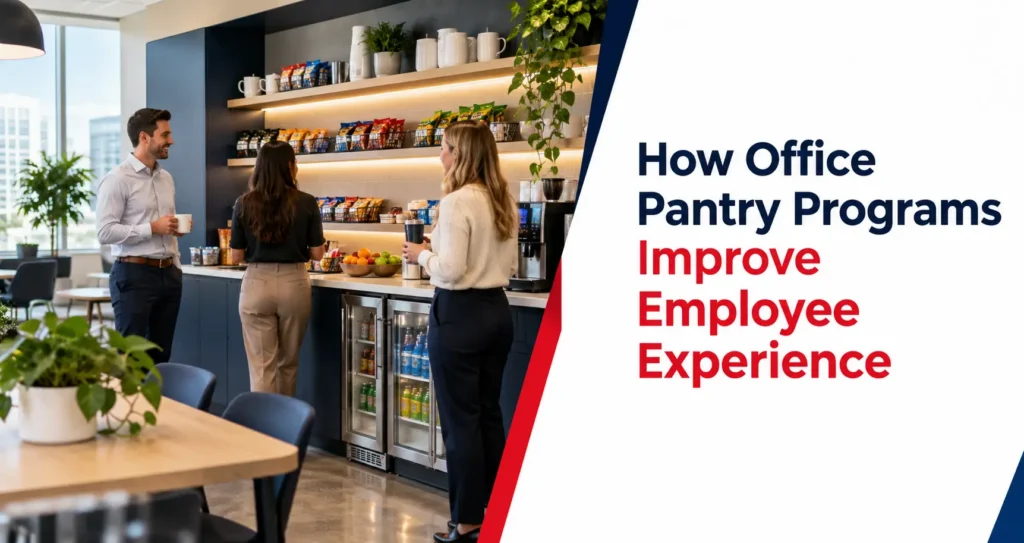
A positive employee experience is shaped by more than major company benefits or occasional appreciation events. Everyday details also influence how people feel about their workplace, from the availability of comfortable break areas to the convenience of getting a snack or beverage between meetings. These smaller interactions may not receive much attention during workplace planning, but employees encounter them throughout their working week.
For businesses looking to improve the daily workplace experience, an office pantry program offers a practical option. By providing employer-sponsored snacks, beverages, and other refreshments, companies can make breaks more convenient while showing employees that their everyday needs are being considered. A well-managed pantry can also reduce the administrative effort required to maintain workplace refreshments, allowing office managers to focus on other responsibilities.
However, providing free snacks does not automatically create a positive workplace culture. The value of an office pantry depends on whether it fits the workforce, offers products employees appreciate, and remains consistently available. A program designed around actual employee needs is more likely to become a meaningful workplace amenity than one introduced simply because other companies offer it.
This guide explores how office pantry programs can support employee experience, contribute to workplace culture, and provide practical convenience for different types of businesses. It also explains how employers can evaluate the value of a pantry program without treating refreshments as a substitute for more important aspects of employee satisfaction.
What Is the Connection Between Office Pantry Programs and Employee Experience?
An office pantry is an employer-sponsored refreshment program that makes selected snacks, beverages, and other food products available to employees. Unlike traditional vending machines, which generally require employees to purchase individual products, a pantry allows companies to provide approved refreshments as a workplace benefit. The assortment and service schedule can be customized around workforce size, employee preferences, and available space.
The connection between an office pantry and employee experience comes from everyday convenience. Employees who have access to refreshments on-site may spend less of their break searching for food, traveling to a nearby store, or bringing additional supplies from home. For workplaces with limited nearby dining options or tightly scheduled breaks, this convenience can be particularly useful.
The program may also communicate something about how an organization treats its employees. When a company considers the products people want, maintains a clean refreshment area, and provides consistent access across shifts, the pantry becomes a visible example of everyday workplace support. Its impact is likely to depend on the overall working environment rather than the presence of snacks alone.
Businesses exploring the broader service model can review our Office Pantry Service & Healthy Snack Programs guide for additional information about pantry planning, product selection, and managed workplace refreshments.
Why Everyday Workplace Amenities Matter to Employees
Employee experience benefits are often discussed in terms of compensation, career development, recognition, and flexible working arrangements. Those priorities remain essential, but employees also notice whether their workplace is comfortable and convenient during an ordinary day. Access to refreshments, functional break areas, and reliable facilities can influence how easy or difficult the working environment feels.
Consider an employee who has several meetings scheduled with limited time between them. Having access to a snack or beverage nearby can make a short break more practical than leaving the building or searching for an alternative. The benefit may seem modest, but it addresses a recurring part of the employee’s day.
The same principle applies to workplaces where people cannot easily leave during shifts. Employees in distribution centers, manufacturing facilities, and other operational environments may have limited opportunities to visit nearby stores. Providing appropriate refreshments on-site gives those teams additional convenience without requiring them to change their work schedules.
Effective workplace experience ideas should therefore consider the practical circumstances employees face. A workplace amenity is most useful when it removes a small but recurring inconvenience, fits normal operations, and is available to the people who need it.
How Office Pantry Programs Can Support Employee Morale
Employee morale is influenced by many factors, including leadership, recognition, communication, workload, and workplace relationships. A pantry program cannot resolve problems in those areas, but it can contribute to an environment where employees feel that their everyday needs receive attention. The distinction is important because meaningful employee morale boosters should complement good workplace practices rather than replace them.
Making Appreciation Part of the Workday
Employee appreciation does not always need to involve a formal event or expensive reward. Sometimes it can take the form of a practical benefit that employees can use regularly. A pantry stocked with snacks and beverages gives people access to something useful without requiring them to wait for a special occasion.
Consistency helps determine whether the program feels meaningful. Employees are more likely to appreciate a refreshment area that remains clean, organized, and appropriately stocked than one that receives attention only when visitors arrive. Everyday reliability can communicate consideration more effectively than an impressive initial setup that is poorly maintained.
Employers should also be realistic about what the benefit represents. Complimentary refreshments are a workplace amenity, not a replacement for competitive pay, fair policies, or recognition. They can contribute to a positive experience when the broader working environment already supports employees.
Giving Employees More Choice
Employee preferences are rarely identical, even within a small team. Some people enjoy traditional packaged snacks, while others prefer fruit, nuts, protein-focused products, or beverages with less added sugar. A thoughtful pantry provides enough variety for employees to make choices that reflect their tastes and dietary needs.
This flexibility can make the program more welcoming. Rather than assuming every employee wants the same products, the business can include a combination of familiar favorites and alternatives. Employees may appreciate having options without feeling that their workplace is trying to control their eating habits.
The best approach is to invite feedback and use it to guide the assortment. When employees see reasonable requests reflected in the pantry, they have a tangible example of workplace input leading to a practical improvement.
Creating Opportunities for Workplace Connection
A shared pantry can provide an informal gathering point within the workplace. Employees may stop for coffee, take a short snack break, or have a conversation with colleagues they do not regularly work alongside. These interactions can happen naturally without requiring the company to organize a formal engagement activity.
For organizations exploring workplace culture ideas, that informal quality can be valuable. Not every workplace connection develops through scheduled meetings or team-building exercises. Sometimes employees become more familiar with colleagues through ordinary conversations during the workday.
A well-designed refreshment area can make those moments more comfortable by providing a convenient place to pause. Comfortable seating, accessible snacks, appropriate lighting, and a clean environment can help employees use the space as intended. The company should still respect individual preferences, since some employees may prefer quiet breaks rather than social interaction.
Supporting Collaboration Without Forcing It
Shared break areas can bring employees from different departments into the same space. A finance employee might briefly speak with someone from operations, or colleagues working on separate projects may encounter one another outside a scheduled meeting. These interactions can encourage familiarity, although collaboration depends on much more than the physical environment.
An office pantry can support this setting by giving people a practical reason to visit a shared area. However, it should not be promoted as a guaranteed way to improve teamwork or productivity. Its role is to make informal interaction possible while allowing employees to decide how they spend their breaks.
Employee Engagement Through Workplace Amenities
Employee engagement through workplace amenities begins with understanding which resources employees actually value. A workplace can invest heavily in an amenity that receives little use, while a relatively simple program may become popular because it addresses a genuine need. The deciding factor is relevance to the workforce, not the appearance or size of the program.
An office pantry can become part of a broader effort to listen to employees and improve everyday working conditions. For example, an employer might learn that employees want more breakfast options during early shifts or additional beverages during afternoon breaks. Responding to those requests demonstrates that feedback is being considered.
Employees should also have a straightforward way to share their experiences after the program launches. A brief survey, an occasional team discussion, or a simple feedback channel can help identify products employees enjoy and practical improvements they would appreciate. The business can then make adjustments without turning the pantry into an unnecessarily complicated initiative.
The most useful engagement opportunities come from genuine responsiveness. Employees are more likely to notice that their opinions matter when the workplace follows through on reasonable requests, whether those requests concern refreshments or other aspects of the environment.
What Types of Refreshments Support a Better Employee Experience?
The product assortment should reflect the people using the workplace rather than a generic list of fashionable snacks. A small professional office may appreciate coffee accompaniments, breakfast items, and familiar packaged products, while a larger facility may need a broader selection suited to different shifts. Available storage, refrigeration, and budget also influence what the company can reasonably provide.
A practical pantry assortment may include:
- Traditional snacks such as crackers, popcorn, granola bars, and other familiar favorites
- Better-for-you choices such as nuts, fruit, whole-grain products, and selected protein snacks
- Breakfast-friendly products for employees arriving early
- Beverages that reflect employee preferences and workplace requirements
- Selected dietary alternatives with clear ingredient and allergen information
- Refrigerated products where suitable equipment and food-handling arrangements are available
The objective is not to provide every possible product. A focused selection that employees regularly use may offer more value than a large assortment with excessive waste. Employers should also make sure that dietary information remains accessible so employees can make their own choices.
Product variety can contribute to a more inclusive refreshment experience, but it should remain practical. Offering alternatives for different preferences is useful, while making unsupported nutritional or allergen-free claims should be avoided.
Office Pantry Programs for Different Working Environments
The employee experience varies considerably between a corporate office, a warehouse, and a manufacturing facility. A pantry program that works well for a traditional office may need adjustments before it becomes suitable for employees with physically demanding roles or rotating shifts. Businesses should consider how employees actually use the workplace before selecting the program.
Corporate Offices and Professional Workplaces
Corporate offices often have employees moving between desks, meetings, shared spaces, and scheduled appointments. A pantry can provide convenient refreshments during those transitions without requiring people to leave the building. Coffee accompaniments, packaged snacks, fruit, and breakfast choices may fit this environment.
Hybrid attendance also affects how employees use office amenities. A workplace may have significantly more people on-site during certain weekdays, which can influence the appropriate quantity of fresh products. A program that reflects attendance patterns is more likely to remain useful without creating unnecessary waste.
Warehouses and Manufacturing Facilities
Operational workplaces often have employees following structured break schedules, working long shifts, or remaining on-site throughout the day. A pantry in this setting should prioritize convenient access, suitable product storage, and availability during different working hours. Snack selections may also need to reflect the preferences of employees performing physically demanding jobs.
Fair access matters particularly when a facility operates multiple shifts. Employees working evenings or overnight should not routinely encounter empty shelves simply because the first shift consumed the available products. A program that considers the entire workforce provides a more consistent amenity experience.
Smaller Offices and Growing Businesses
Smaller organizations do not necessarily need a large pantry installation to provide a useful employee benefit. A compact refreshment area with a focused selection of snacks and beverages may fit a small team and a limited budget. Employees can still appreciate the convenience of having selected refreshments available during the workday.
As the company grows, the assortment and service frequency can be reconsidered. Additional employees may create demand for more product categories or a different stocking arrangement. The initial program should be practical for the current workplace while allowing reasonable adjustments as needs change.
Office Pantry Programs as Part of Workplace Culture
Workplace culture develops through how people are treated, how decisions are made, and how employees experience their working environment. An office pantry is a small part of that picture, but it can reinforce a company’s approach to everyday convenience and employee support. When thoughtfully managed, refreshments become a visible amenity rather than an occasional gesture.
One important consideration is fairness. Employees should understand who can use the pantry, which products are employer-sponsored, and whether access differs between teams or locations. Confusing arrangements can reduce the value of a benefit that was intended to make the workplace more welcoming.
Businesses with multiple departments should also consider whether one central pantry is sufficient. If some employees work far from the main break room or cannot leave their work area easily, a single location may not serve everyone equally. Workplace culture is better supported when practical access is considered alongside the appearance of the amenity.
These are useful workplace culture ideas because they focus on how employees experience the program rather than how the company markets it. A well-run pantry should be straightforward to use, appropriate for the facility, and supported by consistent service.
Why Managed Pantry Service Matters
The employee experience depends partly on whether the pantry continues to function well after the initial launch. A refreshment area that frequently runs out of products or becomes disorganized can create frustration instead of convenience. Reliable replenishment and product management are therefore important parts of the program.
Without a managed arrangement, office administrators may need to purchase snacks, carry supplies, monitor inventory, organize storage, and handle product requests. Those responsibilities can become time-consuming as the workforce grows. A managed pantry service helps move recurring refreshment tasks away from internal teams while allowing the employer to remain involved in important decisions.
Best Vending offers office pantry service for businesses looking to provide selected employer-sponsored refreshments. Programs can be planned around workforce size, company budget, employee preferences, and available space. Ongoing service can support a more consistent pantry experience while reducing the everyday management involved.
A managed program is not automatically the right fit for every workplace. Smaller organizations with limited snack needs may prefer simpler arrangements, while larger or multi-shift employers may benefit from coordinated replenishment. The appropriate approach depends on the scale and complexity of the company’s refreshment requirements.
Office Pantry Programs for Warrenton Businesses
Businesses in Warrenton, Missouri can consider employer-sponsored pantry programs as one way to improve everyday refreshment convenience for their teams. A professional office may need a compact assortment of snacks and beverages, while a larger workplace may benefit from additional product capacity and more frequent service. In either setting, the goal should be to provide a practical amenity that fits daily operations.
For employers with different departments or shift schedules, access should be considered from the beginning. A pantry that serves only the employees working conventional office hours may not provide the same experience to teams operating later in the day. Product selection and replenishment should account for how the entire workforce uses the facility.
Warrenton businesses can also view the pantry as one component of the broader workplace environment. When refreshments are convenient, consistently available, and selected with employee preferences in mind, they can support a more welcoming break area. The program should remain appropriate for the facility rather than becoming an unnecessary operational expense.
Improving Workplace Amenities in Wright City
Employers in Wright City may have different employee experience priorities depending on their workplace size, operating hours, and facility type. A growing office might want to provide snacks as an everyday staff benefit, while a company with extended shifts may focus on dependable access to refreshments throughout the day. The pantry should reflect those differences rather than relying on a standard assortment.
A practical approach is to begin with products employees are likely to use regularly. Familiar snacks, selected healthier options, breakfast products, and beverages can provide variety without making the program unnecessarily complicated. Employee feedback can help the company identify which categories are most useful.
For Wright City workplaces, the value of a pantry lies in its everyday convenience and reliability. Employees should be able to find appropriate refreshments during their breaks without unnecessary effort. A managed program can help employers maintain that consistency while keeping product quantities aligned with actual demand.
How Can Businesses Measure the Value of an Office Pantry?
An office pantry should be evaluated against its intended purpose rather than assumptions about what free refreshments might accomplish. If the goal is employee convenience, the business can ask whether people regularly use the pantry and whether access meets their needs. If the goal is to strengthen workplace amenities, employee feedback can help determine whether the program feels worthwhile.
Some useful indicators include employee satisfaction with the assortment, frequency of pantry use, product availability, and the amount of internal time required to manage the program. These measures provide practical information without attempting to prove that snacks directly cause higher retention or productivity. Larger workplace outcomes are influenced by many factors, so they should not be attributed to one amenity without supporting evidence.
A simple review process can also identify opportunities for improvement. Employee requests may reveal that particular products are missing, while consumption patterns can show whether the assortment is appropriately sized. Adjustments can then be made based on actual workplace experience rather than assumptions.
For businesses using a managed provider, service quality should be part of the evaluation. Consistent stocking, clear communication, and appropriate product rotation are important because even popular refreshments lose value when the pantry is unreliable.
Common Mistakes That Reduce the Employee Experience
An office pantry can be introduced with good intentions and still fail to meet employee expectations. This often happens when the program is designed around appearances rather than the workforce. A visually impressive snack station may receive little appreciation if employees cannot access it conveniently or find products they enjoy.
Businesses should watch for several common issues:
- Selecting products without considering employee preferences
- Offering limited choices for people with different dietary requirements
- Allowing popular products to run out repeatedly
- Designing the pantry around one department while overlooking other teams
- Failing to account for evening or overnight employees
- Treating the pantry as a substitute for more meaningful workplace improvements
Avoiding these mistakes requires thoughtful planning rather than an unusually large budget. A modest program that fits the workplace and receives consistent attention can be more useful than an elaborate setup with poor ongoing service. The focus should remain on employee convenience, reasonable choice, and dependable access.
Building an Office Pantry Program Employees Appreciate
A successful pantry begins with a clear understanding of what the business wants to provide. Some employers want a simple snack and beverage benefit, while others are looking for a more complete refreshment experience. The right program should reflect those objectives while remaining realistic about space, budget, and ongoing requirements.
Employees should also have a voice in the selection. A company does not need to satisfy every product request, but reasonable feedback can help shape a program that people actually use. As workplace needs change, the refreshment selection can be adjusted without redesigning the entire break room.
For businesses across St. Charles County and surrounding Missouri communities, Best Vending can help develop pantry arrangements around workforce needs, preferred products, and service requirements. A practical refreshment program can support everyday employee convenience while reducing internal supply-management responsibilities. Contact Best Vending to discuss a workplace pantry program suited to your team and facility.
Frequently Asked Questions
Office pantry programs can improve everyday convenience by giving employees access to employer-sponsored snacks and beverages during the workday. They may also make break areas more useful and provide a visible example of workplace support. Their overall value depends on product relevance, consistent service, and how well the program fits employees' needs.
An office pantry can contribute to a positive workplace experience by providing a practical amenity employees may appreciate. However, morale is also influenced by leadership, compensation, workload, recognition, and workplace relationships. Refreshments should complement those factors rather than be treated as a guaranteed solution.
A pantry can provide a convenient shared space where employees take breaks and occasionally interact with colleagues. Employer-sponsored refreshments may also communicate consideration for employees' everyday needs. A positive contribution depends on fair access, useful product choices, and reliable service.
Potential benefits include convenient snack access, reduced need for off-site purchases, more useful break areas, and additional employee choice. A managed program may also reduce the time office administrators spend maintaining refreshments. The importance of these benefits varies according to workforce needs and the overall workplace environment.
Yes. Smaller businesses can create compact pantry programs with selected snacks and beverages without requiring a large dedicated space. The assortment can be matched to employee count, available storage, and budget. A modest, consistently maintained program may be more practical than an oversized selection.
Yes. Pantry programs can be organized around different work schedules, including early, evening, and overnight shifts. Employers should consider product availability and replenishment so refreshments are not consistently exhausted before later teams take their breaks. The goal is to provide reasonable access across the workforce.
An employee-focused pantry can provide a mixture of traditional snacks, better-for-you choices, beverages, and selected breakfast products. The exact assortment should reflect employee preferences, available space, and appropriate food-storage requirements. Providing meaningful choice is generally more useful than offering many products from only one category.
Businesses can gather employee feedback, review how frequently the pantry is used, and identify which products are consistently popular. Product availability, service reliability, and convenience should also be considered. These indicators help determine whether the program is meeting its practical goals without assuming that pantry usage alone proves greater engagement or retention.