
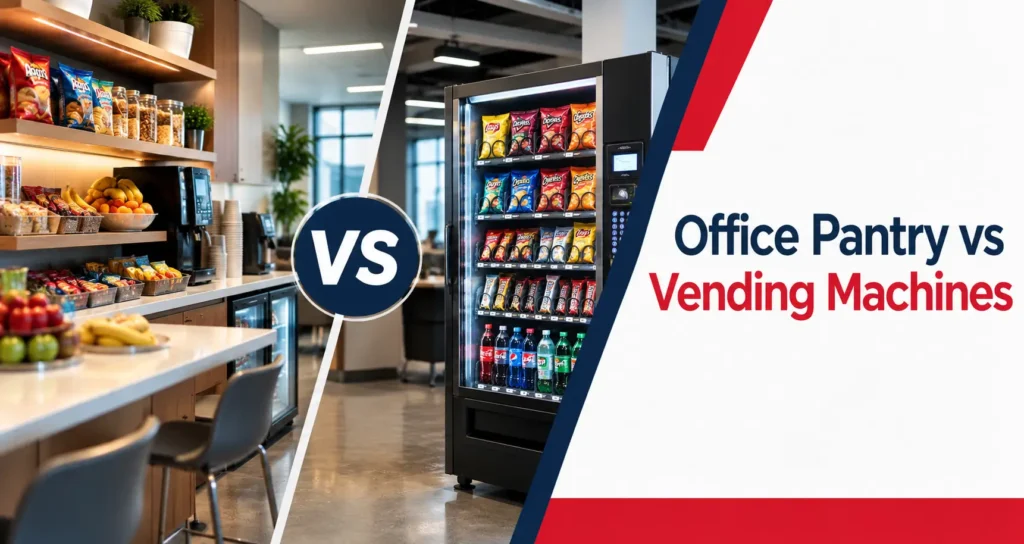
Businesses have several options when it comes to providing food and refreshments at work. An office pantry can give employees access to employer-sponsored snacks and beverages, while vending machines provide a convenient way to purchase individual products throughout the workday. Both approaches can improve access to workplace refreshments, but they create very different experiences for employees and require different management models.
Choosing between an office pantry and vending machine should not come down to which option seems more convenient at first glance. Business owners, office managers, HR teams, and facility managers should consider how employees use the workplace, whether refreshments will be company-sponsored or individually purchased, how much space is available, and how much management the business wants to handle. Businesses looking for a broader overview of pantry planning, healthy snack options, and workplace refreshment programs can also explore our Office Pantry & Healthy Snack Programs guide.
For some businesses, an office pantry makes sense because the company wants to provide snacks and beverages as an employee benefit. For others, vending machines offer a simpler way to provide convenient food and drinks without sponsoring every item. Some workplaces may even benefit from combining the two, particularly when the company wants to provide selected complimentary refreshments while giving employees additional choices through individual purchases.
Office Pantry vs Vending Machines: What Is the Difference?
The main difference between an office pantry and a vending machine is how employees access and pay for refreshments. An office pantry is generally an employer-sponsored workplace amenity where the company selects and provides snacks, beverages, or other food products for employees. Vending machines, on the other hand, usually operate through individual purchases, allowing employees to choose and pay for products when they want them.
The physical setup is also different. A pantry may include open shelves, cabinets, refrigerators, countertops, beverage stations, or a combination of these elements, while vending machines keep products inside automated equipment. That difference affects how much space is required, how employees interact with the service, and how the business manages inventory.
The financial structure is another major consideration. With a pantry, the employer typically funds the products it provides, whereas vending allows employees to pay for individual purchases. Because the two models work differently, businesses should compare them based on employee experience, operational requirements, product variety, and long-term goals.
Office Pantry and Vending Machine Comparison
A direct comparison makes it easier to see how the two workplace refreshment models differ. Neither option is right for every organization, because the choice depends on how the company wants employees to access food and beverages. The following table can help businesses identify which characteristics align more closely with their workplace requirements.
| Feature | Office Pantry | Vending Machines |
|---|---|---|
| Employee Access | Employer-sponsored refreshments | Individual product purchases |
| Payment | Usually no payment at point of use | Employees pay for selected products |
| Product Display | Open shelves, cabinets, refrigerators, or counters | Products displayed inside machines |
| Product Variety | Flexible selection based on employer goals | Limited by machine capacity and configuration |
| Workplace Experience | Employee amenity and shared refreshment space | Convenient self-service purchasing |
| Management | Product planning, stocking, and replenishment | Machine service, inventory management, and restocking |
| Fresh Food | Can be included depending on setup | More limited depending on equipment |
| Space Requirements | May require pantry or break room space | Generally requires less dedicated space |
| Best Fit | Companies providing refreshments as an employee benefit | Workplaces seeking convenient individual purchases |
| Customization | Selection can be built around employee preferences | Selection can be adjusted within machine capacity |
The comparison shows why businesses should not treat an office pantry and vending machine as interchangeable services. A pantry is usually more closely connected to employee benefits, while vending focuses more on convenience and individual choice. A business can also use both models when the workplace has different refreshment objectives.
How an Office Pantry Supports the Workplace
An office pantry provides refreshments as part of the employee experience. Instead of requiring employees to purchase every snack or beverage, the company sponsors a selection of products that employees can access during the workday. This can make the pantry feel more like a workplace amenity than a retail service.
The physical environment can also be customized around the company’s needs. A pantry might include snack shelving, refrigerated products, beverages, breakfast items, coffee supplies, or other refreshments that employees regularly use. Larger organizations may even create dedicated pantry areas as part of their workplace.
For businesses considering this type of program, a managed Office Pantry Service can take care of recurring stocking and refreshment management while allowing the company to determine the type of experience it wants to provide.
How Vending Machines Support the Workplace
Vending machines provide a different type of workplace convenience. Employees can select an individual snack or beverage, complete the purchase, and receive the product immediately without requiring the company to provide every item at no cost. This can make vending particularly practical when employees want flexibility in what they purchase.
Vending equipment can also work well when floor space is limited. Instead of creating a larger pantry area with shelves and refrigeration, a business can use one or more machines to provide access to snacks and beverages within a defined footprint. Modern machines can also support cashless payments, making individual purchases easier.
The product selection can be adjusted according to workplace demand. If employees consistently choose particular snacks or beverages, those products can receive more space, while items with limited demand can be replaced. This allows the vending program to change without requiring the company to manage a full pantry.
Workplace Food Solutions: Which Model Fits Your Business?
The right workplace food solution depends on more than the number of employees in a building. A business should consider how often employees are on-site, how long they typically remain at work, whether multiple shifts operate from the facility, and what food and beverage options already exist nearby. These factors can affect which option works better for the workplace.
Employee expectations should also be part of the decision. Some teams may place more value on complimentary snacks and beverages as an employee benefit, while others may prefer having a larger selection of food and drinks that they can purchase when needed. Understanding those preferences before choosing a program can help prevent spending on options employees do not use.
Before making a decision, businesses should consider:
- Whether refreshments will be employer-sponsored or individually purchased
- How much space is available for food and beverage services
- Whether fresh or refrigerated products are important
- How frequently employees use the workplace
- Whether the business operates multiple shifts
- How much product management the internal team wants to handle
- Whether the program needs to change as employee demand changes
These factors provide a more useful framework than simply asking whether an office pantry or vending machine is better. The goal is to choose a solution that fits the company’s actual workplace needs.
Office Snack Solutions for Different Workplace Sizes
Workplace size can affect which snack solution is practical, but employee count should not be the only deciding factor. A small office with consistent attendance may have stronger product demand than a larger workplace with a heavily hybrid workforce. Daily attendance, break schedules, nearby food options, and employee preferences can all influence how a refreshment program performs.
A small professional office may not need a large pantry area, particularly if employees frequently leave the building for lunch or have restaurants nearby. In that situation, vending machines can provide a compact option for snacks and beverages without requiring a major change to the workplace layout. A focused product selection can also make the program easier to manage.
Medium-sized offices may have enough demand to support either model. The decision at this stage often depends on whether the business wants to provide refreshments as an employee benefit or simply make food and beverages available for purchase. A larger corporate workplace may have enough space and demand for a larger pantry, multiple vending machines, or a combination of both.
Pantry Service vs Vending Machines: Employee Experience
Employee experience is another important difference between the two models. An office pantry creates an environment where employees can browse available refreshments without thinking about individual payment. This makes the pantry feel more like a workplace amenity than a retail service.
Vending machines provide speed and convenience. Employees can walk up, select a product, pay, and continue with their day. This can be particularly useful when employees have short breaks or work in environments where a larger pantry area is not practical.
Companies should therefore ask what they want the refreshment program to accomplish. If the goal is to provide an employer-sponsored amenity, a pantry may be a better fit. If the goal is simply to make food and beverages available for purchase on-site, vending may be sufficient.
Product Variety and Customization
Product selection is another important factor when comparing an office pantry and vending machine. A pantry generally provides more flexibility because products can be displayed across shelves, cabinets, refrigerators, and counters. This allows businesses to offer a broader mix of snacks, beverages, breakfast products, fresh food, and healthier choices.
Vending machines have physical capacity limitations. A machine can still provide a useful assortment, but the number and size of products depend on the machine configuration.
That does not mean vending has to be generic. Businesses can adjust product selections based on employee demand, workplace type, and purchasing patterns. Popular products can receive more space, while products that rarely sell can be replaced.
For businesses that want more product flexibility, pantry programs generally provide more room for customization.
Managing an Office Pantry
An office pantry requires ongoing management because products need to be selected, delivered, stocked, organized, and monitored. For a small business, these responsibilities may initially appear simple, but they can become time-consuming as employee numbers and product variety increase. Someone still needs to monitor supplies, decide what to purchase, organize storage, and remove products that are no longer popular.
Fresh and refrigerated products can create additional management requirements. Businesses need to pay attention to product turnover, storage conditions, and waste when they offer items with shorter shelf lives. A pantry program therefore needs a service process that matches the size and consumption patterns of the workplace.
A managed pantry service can move much of this recurring work to a provider. The business can still establish its budget and preferred product categories while the service partner handles routine stocking and replenishment. This can be useful for office managers and facility teams that do not want refreshment inventory to become another administrative task.
Managing Vending Machines
Vending machines also require regular management, although the process is different from pantry management. Machines need inventory checks, product restocking, equipment maintenance, payment system support, and adjustments when employee demand changes. A machine that frequently runs out of popular products can quickly become less useful to the workplace.
A managed vending program can handle many of these responsibilities on behalf of the business. Product demand can be reviewed so popular items remain available while slower-selling products are reduced or replaced. Equipment issues can also be addressed through the service provider rather than requiring office staff to troubleshoot the machines.
Consistency is important. Employees expect the machine to work when they need it and to contain products they actually want. Regular service and demand-based product selection help keep the program reliable.
Cost Considerations for Office Pantry or Vending Machine Programs
Cost should be evaluated based on the complete program rather than the price of individual snacks. An employer-sponsored pantry means the company is paying for the refreshments it chooses to provide, so the ongoing budget needs to account for product demand, replenishment, storage, and any related service requirements. The company has more control over the employee benefit but also takes on more responsibility for the refreshment budget.
Vending has a different financial structure because employees generally pay for individual products. This means the business does not necessarily fund every snack or beverage consumed, although there can still be costs or service considerations associated with equipment placement, electricity, maintenance arrangements, or other aspects of the program.
Businesses should therefore compare the total operational model rather than asking which option has the lower price per snack. The more important question is whether the chosen model provides the experience the company wants at a sustainable cost.
Workplace Snack Solutions Comparison by Business Goal
Different companies may have completely different reasons for adding workplace snack solutions. One organization may be focused on employee benefits, while another may simply want to make food available during short breaks. Comparing the options against specific business goals can make the choice clearer.
| Business Goal | Office Pantry | Vending Machines |
|---|---|---|
| Provide complimentary employee snacks | Strong fit | Possible with employer subsidy |
| Offer individual product purchases | Not the primary model | Strong fit |
| Create a shared refreshment area | Strong fit | More limited |
| Minimize dedicated space | Moderate fit | Strong fit |
| Offer a broader employer-sponsored selection | Strong fit | More limited |
| Provide quick individual purchases | Moderate | Strong fit |
| Support workplace amenities | Strong fit | Moderate to strong fit |
| Control which products employees receive | Strong fit | Moderate fit |
| Offer fresh food | Possible with suitable setup | More limited depending on equipment |
| Combine with other refreshment services | Strong fit | Strong fit |
This comparison shows that the choice is not simply about food availability. It is also about how the company wants employees to interact with refreshments and what role the program should play within the workplace.
Office Pantry or Vending Machine in Washington?
Businesses in Washington can evaluate an office pantry or vending machine based on the type of workplace they operate and how employees use the facility. A professional office that wants to provide complimentary snacks and beverages as an employee benefit may find a pantry a better fit. A workplace focused on quick individual purchases may find vending more practical.
Available space is another consideration for Washington businesses. A pantry may require shelving, storage, and potentially refrigeration, while vending equipment can provide a more compact refreshment option. Companies should also consider employee schedules, product preferences, and whether refreshments will be employer-sponsored or individually purchased.
Office Pantry or Vending Machine in Union?
For businesses in Union, the decision should begin with how employees will use the refreshment service rather than the equipment itself. A company that wants to provide complimentary refreshments can build a pantry around its preferred products and budget, while a business that wants employees to purchase individual snacks may prefer vending. The two approaches can also be combined when the workplace has different refreshment requirements.
Facility layout can influence the decision as well. A pantry can be integrated into an existing kitchen or break room when the company has suitable storage, while vending machines can provide convenient access without creating a dedicated shopping area. Reviewing employee demand, available space, operating hours, and management needs can help Union businesses choose a practical solution.
When Should a Business Choose an Office Pantry?
An office pantry may be a good fit when the business wants refreshments to be an employer-sponsored workplace amenity rather than an individual purchase option.
It can also make sense when the company has enough space for a dedicated pantry or break area and wants to provide greater product variety. Businesses that value fresh food, healthier choices, breakfast products, and a broader range of refreshments may appreciate the flexibility of an open pantry environment.
A pantry can also make sense when employee experience is an important part of the company’s workplace strategy. It can become part of a broader workplace amenities program rather than simply serving as a place for food and drinks.
When Should a Business Choose Vending Machines?
Vending machines may be a good fit when the business wants a compact and automated way to provide snacks and beverages. They are useful when employees prefer individual purchasing, when the company has limited space, or when the business does not want to sponsor every product. Vending can also provide convenient access in workplaces where employees have short breaks or where a dedicated pantry is not practical.
The product selection can still be customized based on demand, and cashless payment options can make the purchasing process more convenient. For many workplaces, vending provides a straightforward way to offer refreshments without creating a full pantry.
Can a Workplace Use Both an Office Pantry and Vending Machines?
Yes, businesses do not necessarily have to choose one model exclusively. A company could use an office pantry to provide complimentary snacks and beverages while also offering vending machines for additional products that employees purchase individually. This approach can provide an employer-sponsored benefit without requiring the company to fund every possible food and beverage option.
A combined setup can be useful when employees have different preferences or the workplace needs different refreshment options. For example, the company might provide a basic selection of snacks and beverages through the pantry while using vending to offer additional choices. The two programs should be coordinated so that the product selections complement each other rather than unnecessarily overlapping.
How to Choose the Right Workplace Refreshment Solution
To decide between an office pantry and vending machines, start with the business objective. Ask what the company wants to provide, how refreshments should be paid for, how much space is available, and how much internal management the business wants to handle.
It is also useful to speak with employees before making a decision. Their feedback can reveal whether they value complimentary snacks, fresh food, individual purchasing options, healthier products, beverages, or a combination of different choices.
Finally, consider how the program may need to change over time. Workforce size, attendance patterns, office layouts, and employee expectations can change over time. Choose a provider and program that can be adjusted as workplace needs change.
Frequently Asked Questions
An office pantry and vending machines serve different workplace needs. A pantry is generally designed as an employer-sponsored refreshment amenity, while vending machines provide individual product purchases. The right fit depends on company goals, employee preferences, space, and budget.
Pantry service typically provides employer-sponsored snacks and beverages through an open workplace refreshment area. Vending machines store products inside automated equipment and allow employees to purchase individual items.
Yes. Businesses can include healthy snacks such as fruit, nuts, yogurt, protein bars, whole-grain products, and lower-sugar options alongside traditional workplace snacks.
Yes. Vending machines can provide convenient access to snacks and beverages in corporate offices, particularly when businesses want individual purchasing options or have limited space for a larger pantry.
Yes. A business can use an employer-sponsored pantry for complimentary refreshments while using vending machines to provide additional products for individual purchase.
An office pantry generally provides more flexibility because products can be stored across shelves, cabinets, refrigerators, and other areas. Vending machines have more limited capacity based on the equipment configuration.
Vending machines generally require less dedicated space than a full office pantry. However, the right option depends on the size and layout of the workplace and the number of employees being served.
Businesses should consider employee preferences, whether refreshments will be employer-sponsored, available space, product variety, budget, service requirements, and the overall workplace experience they want to create.