Adding vending machines to your workplace can make everyday breaks more convenient. Employees can purchase snacks and beverages without leaving the building, while a professional provider can handle stocking and equipment support. However, before installing vending machines, businesses should understand the terms of their vending machine contract.
A contract is more than permission to place equipment in a break room. It establishes the responsibilities of the vending provider and the workplace, including machine ownership, product selection, restocking, maintenance, costs, and what happens when the service relationship ends.
For businesses in St. Charles County, Missouri, a well-defined agreement can make it easier to manage workplace refreshments without unexpected responsibilities. Whether you operate an office in St. Peters, a distribution facility in Wentzville, or a commercial workplace in O’Fallon, knowing what to review before signing is an important part of choosing the right vending service.
What Is a Vending Machine Contract?
A vending machine contract is a written agreement between a business or property representative and a vending service provider. It explains how vending equipment will be placed, operated, stocked, and maintained at the location.
The agreement generally identifies the participating businesses, the equipment involved, the approved machine location, and the responsibilities of each party. Depending on the arrangement, it may also address electricity, payment processing, commissions, insurance, product pricing, contract duration, and cancellation.
A clear vending machine agreement helps both parties understand what they have agreed to before the equipment arrives. It also creates a reference point if service requirements change, a machine needs to be moved, or either party wants to end the arrangement.
For a workplace manager, the most important question is not simply whether a vending machine can be installed. It is whether the proposed service arrangement will continue to meet employee needs after installation.
How Do Vending Machine Contracts Work?
In a typical managed vending arrangement, the business provides an approved location for the equipment, and the vending provider supplies and operates the machines according to the agreed terms. The provider may handle product purchasing, restocking, payment technology, equipment maintenance, and customer support.
The workplace generally designates a contact person who can coordinate access, communicate employee preferences, and report equipment concerns. The exact responsibilities depend on the agreement, so businesses should not assume that every vending provider offers identical service terms.
The process usually involves three stages:
- Planning and agreement: The business and provider review the facility, employee demand, equipment requirements, and proposed service terms.
- Installation and setup: The provider coordinates delivery, places the equipment in the approved location, tests the machine, and prepares the initial product assortment.
- Ongoing operations: The provider performs the services specified in the agreement, while the business communicates changes in staffing, access, or workplace needs.
Understanding how vending machine contracts work helps employers compare proposals beyond the equipment itself.
For example, two providers may offer similar snack and beverage machines. However, their agreements could differ significantly in product flexibility, restocking responsibilities, repair arrangements, renewal conditions, or removal procedures.
Businesses evaluating professional vending services should consider the complete service relationship, not only the appearance or features of the machine.
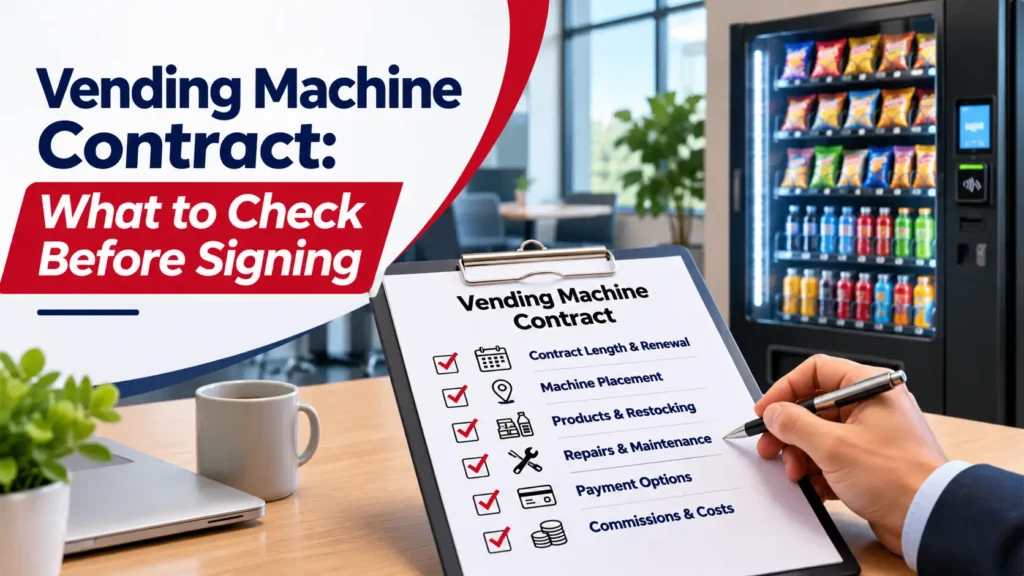
10 Things to Check Before Signing a Vending Machine Contract
Before approving a vending service agreement, review the practical details that will affect everyday operations. A contract should clearly identify the equipment, explain the provider’s responsibilities, and define what the workplace must supply or coordinate.
The following ten areas deserve particular attention.
1. Equipment Ownership and Machine Types
Start by identifying who owns the vending equipment and what types of machines will be installed.
In a provider-managed arrangement, the vending company may retain ownership of the machines while the workplace provides space for their operation. In another arrangement, the business might lease or purchase equipment and take on different responsibilities.
The contract should explain whether the equipment includes snack machines, beverage machines, combination units, or refrigerated food equipment. It should also clarify who has authority to replace, upgrade, relocate, or remove a machine.
Ask whether a change in employee count or product demand could lead to different equipment being recommended later. Understanding these terms helps prevent confusion about who is responsible for the machines throughout the relationship.
2. Machine Placement and Facility Access
A vending machine placement contract should identify the approved location for each machine and outline any building requirements.
The proposed area should be accessible to employees without blocking hallways, entrances, emergency exits, or important workplace operations. The provider should also confirm delivery access, available space, electrical requirements, and any ventilation needs before installation.
Facility access is especially important for warehouses, manufacturing workplaces, and businesses operating outside standard office hours.
For example, a distribution facility near Wentzville may operate several shifts and have specific rules for delivery vehicles or outside service personnel. The vending machine placement agreement should account for reasonable service access while respecting the facility’s security and operating procedures.
The document should also explain whether the equipment can be moved and who must approve a new location.
3. Product Selection and Restocking Responsibilities
A vending program is only useful when the machines contain products employees actually want to purchase.
Before signing, ask how the opening assortment will be selected and whether your workplace can request changes. Product choices may include traditional snacks, bottled beverages, healthier alternatives, and selected refrigerated food options, depending on the machine and service arrangement.
Restocking should also be discussed in practical terms. A location with a small daytime team may have different demand from a larger facility where employees take breaks across multiple shifts.
The agreement should clarify who handles product purchasing, machine filling, inventory rotation, and requests for different products. Businesses should also understand how the provider reviews shortages and changes the assortment as purchasing patterns become clearer.
For additional context, Best Vending’s guide to vending machine inventory management explains how product tracking, demand patterns, and planned replenishment support workplace vending.
A suitable vending service agreement should make it clear who manages the products rather than leaving everyday stocking decisions to an office administrator.
4. Product Pricing and Payment Options
Employees will interact with the payment system every time they make a purchase. For that reason, businesses should ask which payment methods the equipment supports and how product pricing is managed.
Modern vending machines may accept cash, credit cards, debit cards, and contactless payments, including compatible mobile wallets. However, payment availability depends on the equipment and installed payment system.
The agreement should explain who is responsible for payment-processing equipment, transaction problems, and customer refund requests.
You should also ask how product prices are established and whether the provider can adjust them during the contract term. A written process for communicating significant price changes can help prevent misunderstandings between the workplace and its employees.
If your business plans to subsidize employee purchases, discuss how that arrangement would operate and whether additional terms are required.
5. Equipment Repairs and Maintenance
Even well-maintained vending machines can develop mechanical, refrigeration, dispensing, or payment-related issues.
A vending machine contract should explain who is responsible for equipment repairs and how problems should be reported. Businesses should understand whether the vending provider handles technical support directly or coordinates repairs through another service organization.
Ask what happens if a product becomes stuck, a card reader fails, or a refrigerated machine stops cooling properly.
The agreement should also clarify how service requests are acknowledged, who covers applicable repair expenses, and what happens if equipment cannot be restored to normal operation.
Best Vending offers commercial vending machine repair capabilities, including assistance with payment systems, dispensing problems, and refrigeration concerns. However, businesses should confirm the repair provisions applicable to their particular service arrangement rather than assuming every provider offers the same response terms.
Reliable equipment support is an important consideration because a machine that repeatedly stops working can become a source of employee frustration.
6. Costs, Commissions, and Financial Responsibilities
One of the most important parts of a vending machine agreement is understanding the financial arrangement.
Depending on the provider and the location, a vending program may involve different responsibilities for equipment, electricity, installation, product purchasing, payment processing, or machine removal.
Some vending arrangements include commissions or revenue-sharing payments to the host business. Others do not. Employers should never assume that a commission is automatically included or that equipment placement is available without conditions.
If a commission is offered, the agreement should describe how it is calculated, which sales are included, how frequently payments are made, and what records the provider will share.
The same principle applies to costs. If the workplace is responsible for electricity, setup expenses, or other charges, the contract should explain those responsibilities clearly.
A transparent financial arrangement helps businesses compare proposals based on their actual obligations rather than promotional language alone.
7. Insurance, Security, and Damage Responsibilities
Businesses should understand how equipment-related risks will be handled during the agreement.
A vending machine may be installed in a shared employee area, public lobby, warehouse break room, or another location where different people can access it. Depending on the environment, the parties may need to consider equipment damage, property damage, theft, or operational interruptions.
Ask what insurance arrangements apply and whether the provider can supply relevant documentation if required by the property’s management or procurement policies.
The vending machine placement agreement should also explain who must report incidents and who is authorized to service, open, move, or alter the equipment.
For businesses leasing their premises, it may be necessary to confirm that the landlord or property manager permits vending equipment in the proposed area.
Insurance and liability provisions can have legal consequences, so they deserve careful review instead of being treated as routine paperwork.
8. Contract Length and Automatic Renewal
The initial contract term determines how long the parties expect the vending service arrangement to continue.
Some providers may propose a longer initial term, while others may offer different arrangements depending on equipment requirements, expected demand, and the investment involved.
Before signing, confirm the start date, end date, renewal conditions, and any notice required to prevent automatic renewal.
Automatic renewal deserves particular attention. A business may be satisfied with its vending program initially but later change office locations, reduce staffing, or introduce a different break room arrangement.
Reviewing the renewal language early gives your organization an opportunity to plan rather than discovering an upcoming extension after the notice period has passed.
If your business has a procurement or facilities management team, make sure the relevant dates can be tracked internally.
9. Service Changes and Cancellation Terms
Workplace requirements rarely remain identical throughout a long service relationship.
An office may grow, reduce its onsite staffing, move to another building, or change employee schedules. A warehouse may add a shift or require different product quantities during a seasonal increase in activity.
Your vending service agreement should explain how significant changes will be handled.
Ask whether the provider can adjust the machine configuration, product mix, or service arrangements and whether these changes require written approval.
Cancellation terms are equally important. Review how either party can terminate the agreement, what notice is required, whether early termination fees apply, and how unresolved service concerns are handled.
Do not rely on a verbal promise that the contract can be canceled whenever you choose. The written agreement should accurately reflect any cancellation rights discussed before signing.
10. Equipment Removal and End-of-Contract Procedures
Businesses sometimes focus heavily on installation but give little attention to what happens at the end of a vending agreement.
A clear contract should explain who removes the equipment, how removal is coordinated, and whether any applicable charges or responsibilities remain.
Large vending machines may require specialized handling to move through doorways, loading areas, or narrow corridors. The provider and workplace should know how building access and equipment collection will be arranged.
If the business is relocating or changing providers, the agreement should also explain the expected handover process.
Consider whether the contract addresses removal-related damage, outstanding financial matters, or access to the premises after termination.
Clear end-of-contract procedures help businesses avoid unnecessary disruption when they eventually change their break room arrangements.
Vending Machine Placement Agreement vs. Vending Service Agreement
Businesses may encounter several different terms when reviewing vending proposals.
A vending machine placement agreement generally emphasizes permission to install and operate equipment at a specific location. A broader vending service agreement may also describe stocking, product management, repairs, payment systems, and other ongoing responsibilities.
In practice, a single document can cover both placement and service obligations. The title of the document matters less than the responsibilities and conditions written inside it.
| Agreement Area | Placement-Focused Terms | Service-Focused Terms |
| Equipment | Approved machine location and ownership | Machine operation and support |
| Facility | Space, electrical access, and building rules | Access for service personnel |
| Products | Permitted product categories | Selection, stocking, and adjustments |
| Payments | Any financial arrangement with the host | Payment systems, pricing, and refunds |
| Maintenance | Access and responsibility for equipment | Repairs, issue reporting, and service expectations |
| Contract End | Permission to remove equipment | Service transition and outstanding obligations |
A workplace should review all relevant terms regardless of whether the provider calls the document a vending machine placement contract, location agreement, or service contract.
The goal is to ensure that the written arrangement matches the actual workplace vending program being proposed.
What Should a Business Ask About Service Quality?
Contract terms are important, but businesses should also understand how the vending program will operate in practice.
A provider may describe its service as fully managed without explaining exactly how that management works. Asking specific operational questions can reveal whether the proposed arrangement is suitable for your workplace.
For example, ask how the provider responds when popular products sell out, how employee feedback is collected, and who should be contacted when the machine develops a problem.
You should also discuss how the provider prepares for changes in demand. A machine serving a facility with regular overtime may require different inventory planning from one serving a small office with predictable attendance.
Some providers use sales and inventory information to help plan service visits. Others rely more heavily on scheduled inspections and onsite observations. Neither approach should be assumed without discussing the equipment and service available at your location.
These conversations help businesses evaluate service quality before committing to an agreement.
Common Red Flags in a Vending Machine Contract
Not every unusual contract provision is necessarily inappropriate. However, unclear responsibilities or terms that do not match the provider’s explanation should be reviewed before signing.
Some warning signs include:
- Unclear fees: The agreement does not explain who is responsible for equipment-related charges or other expenses.
- Hidden renewal conditions: Automatic renewal or notice requirements are difficult to identify.
- Vague repair responsibilities: The contract does not establish who handles equipment problems or how requests are submitted.
- Unclear commission calculations: Any proposed revenue share lacks a defined calculation or reporting method.
- Restrictive service provisions: Exclusivity or access restrictions are broader than the business expected.
- Uncertain cancellation procedures: The agreement does not clearly explain how either party can end the relationship.
A business should also be cautious when important promises appear only in sales conversations rather than in the written agreement.
If the contract contains language you do not understand, ask for clarification before approving it. Larger organizations may also benefit from having their legal or procurement teams review the final document.
Taking time to resolve these issues can prevent avoidable disagreements after installation.
Vending Machine Contracts for St. Charles County Businesses
Different workplaces throughout St. Charles County have different vending requirements. A suitable contract should reflect how the individual facility operates rather than relying on identical assumptions for every location.
For example, a professional office in St. Peters may want convenient access to packaged snacks and beverages during standard business hours. The agreement should reflect actual onsite attendance, available break room space, and product preferences.
A warehouse in Wentzville may have employees working across several shifts. In that setting, the business may need to discuss product capacity, service access, restocking expectations, and how equipment issues are reported outside normal office hours.
An O’Fallon workplace with a combination of office and operational employees may require a different assortment or machine location than a building serving primarily administrative staff.
These examples illustrate why businesses should provide accurate information about employee numbers, facility access, and daily routines during the planning process.
Best Vending is a third-generation, family-owned company that has served the region since 1978. Its workplace refreshment offerings include managed vending, product stocking, modern payment options, and commercial equipment support for St. Charles County and surrounding Missouri communities.
Local service familiarity can be valuable, but businesses should still evaluate the specific written terms offered for their facility.
How to Compare Vending Service Proposals
When comparing providers, create a simple review process that looks beyond machine appearance and product variety.
Start by confirming that each provider understands your workplace’s size, staffing schedule, break room space, and likely product demand. Then review the proposed machine configuration and the responsibilities described in the agreement.
A proposal should make clear what the provider will handle and what the business must coordinate. This includes restocking, product changes, payment issues, repairs, building access, and contract administration.
Next, compare the financial terms and cancellation provisions. A proposal that initially appears convenient may involve responsibilities or restrictions that only become obvious when the agreement is read in full.
Finally, identify who will serve as the ongoing contact on both sides. Clear communication can be just as important as equipment features when the vending program has been operating for several months.
Businesses that have not yet selected equipment can also review how a workplace vending machine installation works to better understand the planning and setup process.
Before You Sign: Make Sure the Agreement Fits Your Workplace
A good vending program should make workplace refreshments easier to manage, not introduce confusing responsibilities.
Before signing a vending machine contract, confirm that the equipment suits your available space, the products match employee preferences, and the service arrangements reflect your business’s daily operations.
Review the details about restocking, payment technology, repair support, financial responsibilities, renewals, and cancellation. Make sure the final document accurately reflects what was discussed with the provider.
If you are evaluating workplace vending options in St. Charles County or surrounding Missouri communities, contact Best Vending to discuss your facility’s needs and the service arrangements available for your location.
Taking time to understand the agreement before installation is one of the simplest ways to build a workplace vending program with clear expectations from the start.
Frequently Asked Questions
A vending machine contract defines the responsibilities of the vending provider and the business hosting the equipment. It can cover placement, equipment ownership, restocking, repairs, financial terms, and cancellation procedures. The purpose is to establish clear expectations before installation and throughout the service relationship.
In a managed vending arrangement, the business generally provides an approved location while the provider operates and services the machines under the agreed terms. The provider's responsibilities may include stocking, maintenance, payment systems, and product management. The exact arrangement should be confirmed in the written contract.
Not always. A placement agreement generally focuses on permission to install and operate vending equipment at a location, while a service agreement may describe ongoing stocking, repairs, payment support, and related responsibilities. A single contract can include both types of terms.
Electricity responsibilities depend on the contract. Some arrangements require the host business to provide electrical power, while others may allocate costs differently. Before signing, confirm the machine's electrical requirements and which party will pay for its operation.
Many managed vending arrangements allow businesses to communicate employee product preferences and request changes. Available selections depend on supplier availability, machine capacity, demand, and the agreed service program. Businesses should confirm how product requests and assortment changes will be handled.
The reporting and repair process should be established in the service agreement. It may explain how to contact the provider, how refunds are handled, and who is responsible for technical repairs. Businesses should confirm these procedures before installing equipment.
Early cancellation depends on the agreement's terms. Some contracts may permit termination with notice, while others may include additional requirements or charges. Review the cancellation, renewal, and equipment removal provisions before signing rather than assuming the service can be ended immediately.
Legal review can be useful, particularly when an agreement includes long-term commitments, exclusivity, commissions, significant financial obligations, or complicated termination provisions. A qualified attorney can explain the legal implications of the terms and help the business understand its responsibilities before signing.