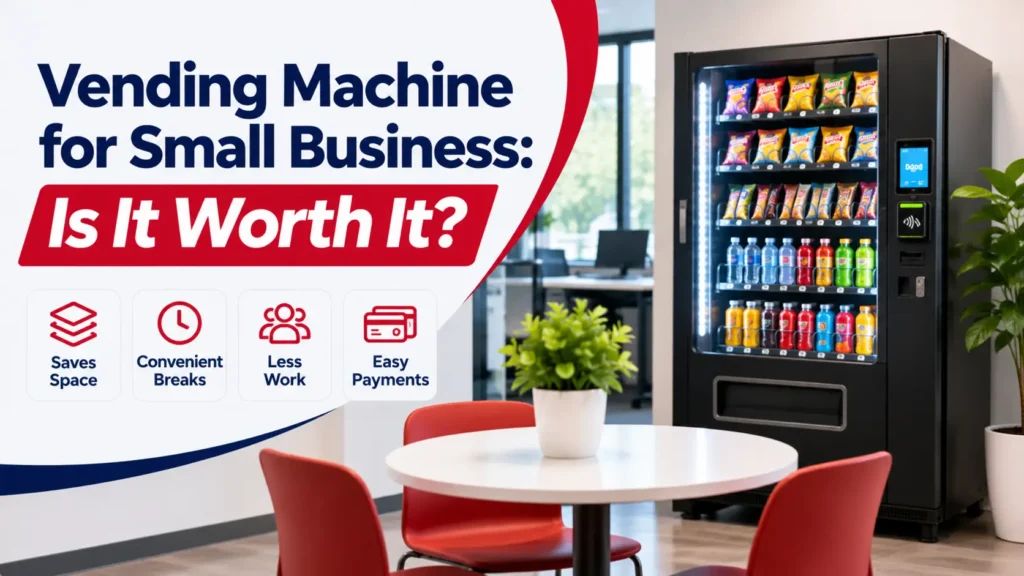
A vending machine for small business can be a practical way to give employees and visitors access to snacks and drinks without requiring a large break room or cafeteria. Many smaller workplaces have limited space and staff, so a convenient refreshment option that does not require daily attention can be valuable.
However, not every small business needs the same equipment. An office with 15 employees working standard business hours may have different refreshment needs from a warehouse with 40 employees working across multiple shifts. Employee attendance, available space, product preferences, and access to nearby food options all influence whether vending makes sense.
Modern vending machines also offer more flexibility than older equipment. Depending on the model, businesses can provide card and contactless payment options, different product selections, and equipment that supports remote inventory monitoring. The key is choosing a setup that suits the actual workplace rather than installing a large machine simply because one is available.
Why Consider a Vending Machine for Small Business?
Small businesses often have to make careful decisions about workplace amenities. Adding a full kitchen or staffed food area may not be practical, especially when employees need only occasional access to snacks or beverages.
A vending machine offers a more compact alternative. Employees can purchase something during a short break without leaving the building, while a managed service provider can handle many of the responsibilities involved in keeping the machine stocked and operational.
For example, a professional office in St. Peters, Missouri, may have employees who need convenient access to drinks and packaged snacks between appointments. Similarly, a small industrial workplace in Wentzville may have staff working longer or less conventional schedules, making onsite refreshments useful when nearby food options are limited.
Best Vending provides managed vending services for businesses in St. Charles County and surrounding Missouri communities. The appropriate arrangement depends on workplace demand, available space, equipment requirements, and the level of service needed.
For small businesses, the goal should be to create a refreshment program that employees will actually use without adding unnecessary work for the business owner or office manager.
What Are the Benefits of a Vending Machine for Small Business?
A well-planned vending program can offer several practical advantages. The most important benefits usually relate to convenience, workplace space, employee choice, and the ability to manage refreshments without assigning additional responsibilities to staff.
1. It Makes Better Use of Limited Space
Small businesses do not always have a dedicated cafeteria or a large employee break room. In many cases, the available refreshment area may be a shared office corner, a compact staff room, or an existing space near the employee entrance.
Small vending machines for offices can be useful in these environments when a suitable compact model is available. A combination machine may hold both snacks and beverages in one unit, reducing the need for separate equipment.
However, even compact machines need adequate clearance, appropriate electrical access, ventilation, and room for employees to make purchases comfortably. Businesses should confirm these requirements before selecting a location rather than assuming any unused corner will work.
2. It Makes Employee Breaks More Convenient
Employees may not have enough time to leave the workplace whenever they want a drink or something to eat. This is particularly relevant for reception staff, customer-service teams, warehouse employees, and people working scheduled shifts.
A small office vending machine can offer commonly requested products such as bottled water, soda, chips, crackers, granola bars, and other packaged snacks. Employees can make a quick purchase without spending part of their break traveling to a convenience store.
The benefit is not necessarily about replacing lunch options. For many small workplaces, vending simply provides a convenient way to handle smaller purchases throughout the day.
3. It Reduces Day-to-Day Refreshment Management
Small business owners and office managers already manage numerous responsibilities. Purchasing snacks, monitoring supplies, collecting payments, and dealing with equipment problems can create extra work if refreshments are managed internally.
With a professionally managed program, the vending provider can take responsibility for agreed services such as product replenishment, equipment support, and monitoring usage. The employer can focus on communicating employee preferences and providing appropriate access for servicing.
The exact responsibilities should be confirmed in the service agreement. This is especially important for smaller workplaces that do not have a dedicated facilities management team.
4. It Gives Employees More Product Choices
Employee preferences vary, even within a relatively small team. Some people prefer traditional snacks, while others may look for bottled water, protein bars, nuts, or lower-sugar beverages.
A vending machine can provide a selection of familiar favorites alongside better-for-you choices. The assortment does not need to be extensive at first. Starting with products employees already enjoy and reviewing demand can be more effective than filling the machine with items that rarely sell.
Over time, purchasing patterns and employee suggestions can help determine which products deserve more space.
5. It Offers Convenient Payment Methods
Many modern vending machines for small businesses support credit cards, debit cards, and contactless payments. Compatible machines may also support mobile wallets such as Apple Pay and Google Pay.
This can make purchasing easier for employees who do not regularly carry cash. However, businesses should confirm the available payment methods before installation because features depend on the equipment and payment system.
For a closer look at reader compatibility, contactless transactions, and payment-related considerations, read our guide to vending machine payment methods.
How Do You Know if a Vending Machine for Small Business Is Right for You?
Before requesting a machine, consider whether the number of potential users and their purchasing habits are likely to support a practical vending program. A smaller employee count does not automatically rule out vending, but low or inconsistent demand may limit the equipment options available.
A business with 30 employees onsite every day may create steadier demand than a company with 50 employees who work remotely most of the week. Similarly, a workplace operating several shifts may benefit from extended access to refreshments even if each shift has relatively few employees.
Review these factors before choosing equipment:
- Employee count and attendance: How many people regularly work onsite, and how consistent is daily attendance?
- Operating hours: Do employees work standard office hours, evenings, weekends, or overnight shifts?
- Nearby food options: Can employees easily purchase refreshments nearby, or would onsite vending provide a more convenient alternative?
- Available space: Is there enough room for a machine, electrical access, ventilation, and comfortable employee movement?
- Product demand: Which snacks and beverages do employees actually want to buy?
- Service requirements: How frequently might the machine need attention, and what access can the provider have to the building?
These considerations are particularly relevant for small workplaces across St. Charles County, including offices, repair businesses, distribution facilities, and other commercial locations.
The answers can help a vending provider determine whether a compact combination machine, a single-category machine, or another refreshment arrangement would be a better fit.
What Are the Best Vending Machine Options for Small Business?
Not every workplace needs two full-sized vending machines. There are several vending machine options for small business locations, and each serves a different purpose.
| Machine Type | Suitable Workplace Need | Important Consideration |
| Combination vending machine | A smaller workplace wanting snacks and drinks in one unit | Limited capacity for each product category |
| Snack vending machine | Offices where packaged snacks are the main priority | Separate beverage access may be needed |
| Beverage vending machine | Businesses with consistent demand for cold drinks | Requires refrigeration and suitable electrical access |
| Refrigerated food vending machine | Workplaces needing sandwiches, meals, or other chilled options | Requires reliable demand, refrigeration, and closer product rotation |
For a small office, a combination machine may be a practical starting point because it can provide several product categories without requiring separate machines. However, a location where employees primarily purchase bottled water or other drinks may benefit from a beverage-focused setup.
Refrigerated food machines require more careful planning. Fresh products need appropriate temperatures, expiration-date checks, and enough purchasing demand to support replenishment.
The best equipment is not necessarily the smallest or most advanced machine. It is the machine that matches employee demand, fits the available space, and can be serviced effectively.
What Should a Small Business Put in Its Vending Machine?
The product selection should reflect what employees are likely to purchase during their normal workday. A compact machine has limited capacity, so every selection should have a purpose.
A small office with employees working at desks may have different preferences from a service workshop where staff spend much of the day performing physical tasks. The opening assortment should consider those differences without relying on assumptions about every employee.
Common workplace vending products include:
- Cold beverages: Bottled water, soda, sparkling water, iced tea, and other popular drinks.
- Traditional snacks: Chips, pretzels, crackers, popcorn, cookies, and candy.
- Better-for-you choices: Nuts, trail mix, granola bars, protein bars, and selected lower-sugar snacks.
- Convenient food options: Packaged breakfast items or refrigerated products where suitable equipment and demand are available.
It is usually more useful to begin with a manageable assortment than to offer too many products that sell slowly. Popular items can receive more space, while less frequently purchased products can be reconsidered.
Employee feedback is useful, but actual purchases also matter. A product that receives several requests may not sell consistently once placed in the machine. Reviewing both feedback and sales patterns helps create a more practical selection.
What Does an Office Vending Machine Setup Involve?
An office vending machine setup begins with understanding the workplace rather than choosing equipment immediately. The provider should review the available space, electrical requirements, daily attendance, building access, and preferred products before recommending a machine.
First, choose a location that employees can reach comfortably. The area should not obstruct doors, walkways, or emergency access routes, and it should allow the clearance required by the equipment manufacturer.
Next, consider machine capacity and product needs. A small office vending machine may provide enough variety for a team with predictable snack purchases, while a business with heavier beverage demand may need a different configuration.
The provider and business should then discuss payment methods, installation arrangements, restocking, equipment support, and any responsibilities identified in the service agreement. These details should be clear before the equipment arrives.
Businesses planning their first installation can learn more from our guide on how to get a vending machine installed at your workplace, which covers site planning, machine selection, and the information needed before setup.
A suitable installation process helps avoid common problems such as insufficient space, poor machine placement, or equipment that does not match actual demand.
How Often Should Small Business Vending Machines Be Restocked?
Restocking frequency depends on how quickly employees purchase products, the machine’s capacity, and the types of refreshments available. Small workplaces generally have different stocking requirements from large warehouses or high-traffic facilities.
An office with steady weekday attendance may need less frequent replenishment than a location operating across multiple shifts. However, even a small team can create substantial demand if vending is the only convenient source of refreshments onsite.
The provider should consider purchasing patterns rather than relying only on employee count. If bottled water repeatedly sells out before the next visit, the machine may need additional beverage capacity or a different replenishment schedule.
Fresh-food products require closer monitoring because refrigeration, product rotation, and expiration dates affect their availability. Shelf-stable packaged snacks generally offer more flexibility, although they still need regular checks.
Best Vending’s article on how often workplace vending machines should be restocked explains the factors that influence service frequency across offices, warehouses, and other facilities.
What Are the Possible Downsides of Vending Machines for Small Businesses?
Vending is not necessarily the right solution for every small workplace. The most important limitation is often insufficient purchasing demand. If only a handful of employees use the machine occasionally, there may not be enough regular activity to justify the equipment and ongoing service requirements.
Space can also be a challenge. Even a small machine needs adequate access and clearance, and refrigerated models require appropriate electrical conditions. A business should not compromise employee movement or safety simply to fit a machine into an available area.
Another consideration is product variety. Smaller machines generally have less capacity, which can limit the number of snack and beverage selections. If employees have very different preferences, the workplace may need to prioritize the most frequently purchased products.
Service quality is equally important. A machine that is repeatedly empty or unavailable due to technical problems will be less useful to employees. Businesses should clarify who manages replenishment, payment problems, maintenance, and customer requests before agreeing to a program.
These limitations do not mean small businesses should avoid vending. They mean the proposed arrangement should be evaluated against actual demand rather than assuming every location needs the same type of machine.
How Can a Small Business Get the Most From Its Vending Machine?
The most effective approach is to make the vending program responsive to how employees use it. Start with products that have clear demand, monitor purchasing patterns, and adjust the selection when certain items consistently sell out or remain unsold.
A small office in O’Fallon may prefer lighter snacks, bottled water, and coffee-related beverages, while a warehouse or workshop near Wentzville may experience greater demand for cold drinks and more filling packaged snacks. These are examples of possible workplace preferences, not fixed rules for businesses in either city.
Payment convenience also matters. If employees regularly use cards or mobile wallets, a compatible cashless payment system can make the machine more accessible.
Businesses should maintain communication with the vending provider as employee numbers, schedules, and product preferences change. For example, a growing business may need additional machine capacity, while an office introducing hybrid work schedules may need its stock levels reviewed.
Our guide to vending machine inventory management explains how product movement, purchasing data, and employee feedback can help shape a more effective assortment.
Is a Vending Machine a Smart Choice for a Small Business?
A vending machine for small business can be a smart addition when employees have consistent refreshment needs and the workplace has enough space for suitable equipment. It provides convenient access to snacks and beverages without requiring the company to operate a staffed food area.
However, the decision should be based on practical needs rather than employee count alone. A small business with steady onsite attendance may be a stronger candidate than a larger organization where very few employees use the building each day.
For businesses in St. Charles County and surrounding Missouri communities, choosing a provider that understands local workplace needs can also make service planning easier. The right discussion should cover equipment capacity, snack and drink preferences, cashless payments, replenishment, and what happens when a machine needs attention.
Ultimately, a vending program works best when it is convenient for employees and manageable for the business. Choosing suitable equipment and setting clear service expectations are more important than installing the largest machine available.
Frequently Asked Questions
It can be worthwhile when employees or visitors have consistent demand for snacks and beverages. Businesses should consider daily attendance, available space, nearby food options, and service requirements before deciding whether vending is appropriate.
There is no universal employee minimum that applies to every provider or workplace. Equipment suitability depends on expected purchases, operating schedules, available space, and service considerations. Smaller locations should discuss realistic demand with the vending provider before requesting installation.
A combination machine can be useful when employees want both snacks and beverages but available space is limited. A dedicated snack or beverage machine may be better when demand is concentrated in one category. The right choice depends on usage and equipment requirements.
Yes. Many modern vending machines support credit and debit cards, while compatible models also accept contactless cards and mobile-wallet payments. Businesses should confirm the supported payment methods before installation.
The schedule depends on product demand, machine capacity, employee attendance, and the type of products being sold. A smaller office may need less frequent replenishment than a busy multi-shift facility, but the actual schedule should be adjusted to purchasing patterns.
Review the number of regular users, operating hours, available space, power requirements, desired products, payment options, and provider responsibilities. A clear understanding of these factors can help determine whether vending is practical and which setup would be most suitable.