
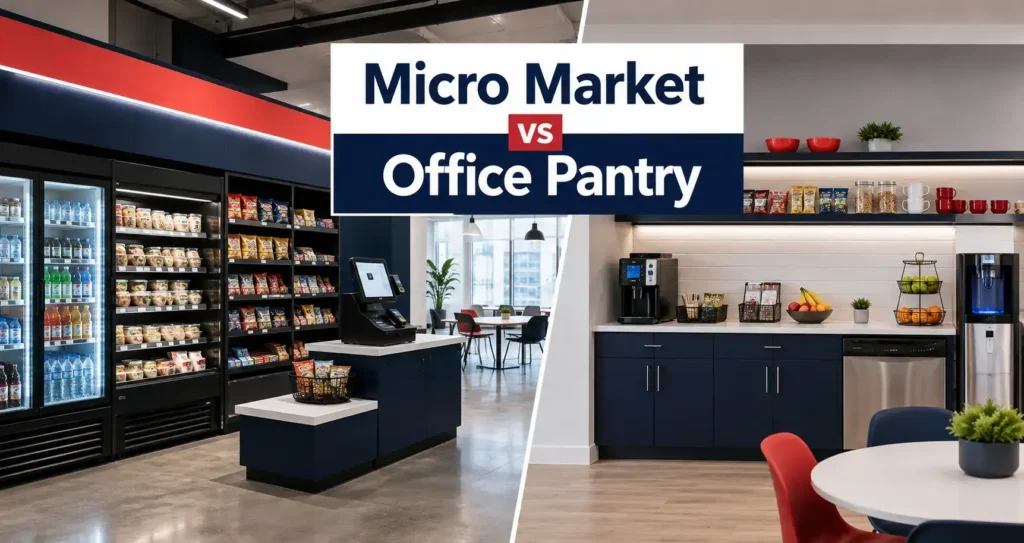
A workplace break room can be structured in several ways, but two of the most flexible options are a micro market and an office pantry. Both give employees convenient access to food and beverages inside the workplace, yet they use very different payment models, product strategies, and employer involvement.
Understanding the difference between a micro market and an office pantry can help employers choose a program that fits their workforce, budget, company culture, and available break room space. Some workplaces benefit from employee-paid self-checkout, while others prefer to provide selected refreshments as an employer-sponsored amenity. In certain cases, using both services together can create an even more complete break room.
Businesses comparing workplace refreshment options can also review our complete micro market vending guide to understand how these programs work, including setup, products, technology, and ongoing service.
What Is the Main Difference Between a Micro Market and an Office Pantry?
The biggest difference is who pays for the refreshments. In a micro market, employees generally select products from open shelves or refrigerated coolers and purchase them through a self-checkout kiosk. In an office pantry, the employer typically funds selected snacks, beverages, or other refreshments that employees can access as part of the workplace program.
The service experience also differs. Micro markets are designed more like compact unattended stores, while office pantries are usually organized around employer-provided products. Both models can include regular restocking, product rotation, and customization, but they support different business goals and employee expectations.
How a Micro Market Works
A micro market uses open shelving, refrigerated cases, product displays, and self-checkout technology to create a small retail environment inside the workplace. Employees browse the available products, select what they want, scan their items, and complete payment without a cashier.
The market can include packaged snacks, fresh meals, sandwiches, salads, breakfast foods, bottled beverages, protein products, and other grab-and-go choices. Because employees pay for individual purchases, the workplace can offer a broader assortment without directly covering the cost of every item.
Businesses considering this format can review Best Vending’s micro market services to see how open shelving, refrigeration, checkout technology, and product management fit into a complete workplace program.
How an Office Pantry Works
An office pantry program is employer-sponsored, which means the company chooses refreshments to provide for employees. Depending on the program, that may include packaged snacks, beverages, breakfast products, healthy options, coffee-related items, or other workplace refreshments.
The employer determines the level of support, product categories, and program budget. The pantry service provider can then stock and maintain the selected assortment based on usage and workplace preferences.
Best Vending’s office pantry service is designed for workplaces that want to provide selected refreshments directly to employees rather than requiring a purchase at checkout.
Micro Market vs Office Pantry at a Glance
A direct comparison makes it easier to understand where the two models differ. Both can improve access to onsite refreshments, but they are designed around different financial structures and employee experiences.
The right choice depends on what the employer wants to accomplish. A business focused on broad food variety may prefer a micro market, while an organization using snacks as an employee amenity may find an employer-sponsored pantry more suitable.
| Feature | Micro Market | Office Pantry |
| Who typically pays? | Employees purchase products | Employer sponsors selected products |
| Checkout required? | Yes, usually self-checkout | Usually no employee checkout |
| Fresh food capacity | Strong | Depends on program |
| Product variety | Broad | Selected by employer |
| Refrigeration | Common | Optional depending on products |
| Employee choice | Employees choose what to buy | Employees choose from employer-provided items |
| Budget structure | Employee purchases support usage | Employer controls refreshment budget |
| Best fit | Workplaces wanting broad food access | Workplaces offering refreshments as an employee amenity |
| Technology | Kiosk, payment system, inventory tools | Usually simpler product-access model |
| Customization | Based on sales and requests | Based on employer goals and employee usage |
Which Option Provides More Product Variety?
A micro market usually supports a broader product assortment because employees purchase individual items. Fresh meals, snacks, beverages, and breakfast foods can all be offered without requiring the employer to sponsor the full selection.
An office pantry can still provide meaningful variety, but the assortment is normally tied more closely to the employer’s budget and refreshment goals. Instead of offering a full retail selection, the program may concentrate on selected snacks, beverages, or wellness-focused items that the company wants to make available to employees.
Fresh Food and Meal Options
Fresh food is one of the strongest advantages of a micro market. Refrigerated cases can support complete lunch and breakfast options, which may be especially useful at workplaces where employees have limited time to leave the property.
A pantry can include refrigerated products, but fresh meals may increase the employer’s direct cost and require more careful planning around usage. For that reason, many pantry programs focus more heavily on snacks and beverages rather than full meal replacement.
Packaged Snacks and Everyday Refreshments
Both programs can perform well when the main objective is convenient access to snacks. Chips, crackers, nuts, protein bars, trail mix, cookies, and similar products can work in either format.
The main difference remains payment. In a micro market, employees choose whether to purchase a snack. In an office pantry, the employer has already chosen to provide that product as part of the workplace amenity.
Beverage Selection
Cold beverages can also be included in both models. A micro market may carry water, soda, sparkling water, tea, juice, energy drinks, sports drinks, and other packaged beverages for purchase.
An employer-sponsored pantry may provide selected beverages directly, particularly when the company wants to make water, sparkling drinks, or certain refreshments available as an ongoing employee benefit.
How Cost Structure Changes the Decision
Cost is one of the most important differences when comparing an office pantry vs. a micro market. With a micro market, employees generally pay for what they select, while the employer provides the space and supports access to the service. The exact service arrangement depends on the provider, workforce size, expected usage, and location requirements.
An office pantry places more of the refreshment cost directly on the employer because the company is sponsoring the available products. That creates greater control over what employees receive, but it also means the program should be planned around an appropriate ongoing budget rather than treated as an unlimited supply of snacks.
Micro Market Budget Model
A micro market can provide broad food access without requiring the employer to purchase every meal or beverage. Employees choose which products they want and complete payment through the checkout system.
This model can be useful for businesses that want a substantial break room food program but do not want to fund the entire assortment directly. The employer can still decide to subsidize selected items or support certain categories depending on the service arrangement.
Office Pantry Budget Model
An office pantry is more directly tied to employer spending. The company can determine how much it wants to invest in refreshments and then select products that fit that budget.
Some employers may focus on coffee, water, and packaged snacks, while others may provide broader selections. The program can be adjusted as employee count, usage, and company priorities change.
Hybrid Employer-Sponsored Programs
The decision does not always have to be one service or the other. Some workplaces may sponsor selected snacks, drinks, or breakfast products through a pantry while allowing employees to purchase additional meals and premium products through a micro market.
This hybrid structure can give employees access to both employer-provided refreshments and a broader paid selection without requiring the company to sponsor everything available in the break room.
Which Option Is Better for Employee Experience?
Employee experience depends on what the workforce values most. Some employees appreciate having a wide selection of meals and drinks available whenever they need them, while others may value the convenience of snacks and beverages provided directly by their employer.
A micro market emphasizes choice and independence. An office pantry emphasizes employer-sponsored access. Neither approach is automatically better for every workplace, which is why employee schedules, company culture, break patterns, and existing amenities should all influence the decision.
Micro Markets Support More Personal Choice
Employees using a micro market can decide what they want to purchase and how much they want to spend. One person may choose a full lunch, another may only buy bottled water, and someone else may pick up breakfast before an early shift.
This flexibility can be valuable in workplaces with diverse food preferences because the provider can maintain a wider assortment than would normally be practical in a fully employer-funded pantry.
Office Pantries Feel More Like an Employer Benefit
An office pantry is directly connected to the employer’s workplace experience because employees do not typically pay each time they take a sponsored item. That can make the program feel more like an employee amenity rather than an onsite retail service.
Companies may use pantry programs to support meetings, hybrid workdays, recruitment, employee appreciation, or everyday break room convenience.
Different Workforces Value Different Things
A professional office may place greater value on employer-sponsored snacks and beverages, especially if employees spend much of the day at desks and already have nearby lunch options.
A warehouse or manufacturing facility may place greater value on fresh meals, larger beverages, and products available across several shifts. Those conditions may make a micro market more practical.
Which Service Works Better for Different Workplace Sizes?
Workforce size affects product demand, service frequency, and the amount of refreshment inventory a location can reasonably support. Larger workplaces may generate enough activity for a broad micro market, while smaller offices may find an office pantry easier to manage.
Size alone should not determine the decision. Employee attendance, hybrid schedules, visitor traffic, shift structure, and nearby food access can change how heavily a break room program is used.
Small Offices
A small office may find an employer-sponsored pantry easier to scale because the business can choose a focused group of products based on budget and employee preferences. Smaller workplaces considering a compact self-service option can also review our guide on small office micro markets to understand how space, employee count, and product selection affect the setup.
A full micro market may still work in some smaller locations, particularly where employees stay onsite for meals, but the provider needs to determine whether usage can support the equipment, fresh-food inventory, and service requirements.
Medium-Sized Workplaces
Medium-sized offices, dealerships, healthcare workplaces, schools, and service facilities may be suitable for either program. The decision often depends on whether the company wants to pay for refreshments directly or provide employees with a broader retail-style selection.
These workplaces can also be strong candidates for a combination program where sponsored snacks are offered alongside employee-paid fresh meals.
Large and Multi-Shift Facilities
Warehouses, distribution centers, manufacturing plants, and other multi-shift operations often benefit from a micro market because the format can provide breakfast, lunch, snacks, and beverages beyond normal business hours. Facilities with multiple shifts can learn more about planning these environments in our guide on warehouse micro markets, including product needs, traffic patterns, and service considerations.
An office pantry may still complement the market by providing selected employer-sponsored products, but using a pantry alone for a very large workforce can create substantial ongoing product demand.
How Space and Layout Affect the Choice
A micro market usually requires more dedicated space because the setup may include open shelving, refrigerated cases, a checkout kiosk, product displays, and room for employees to browse. The break room needs to accommodate both shopping activity and existing functions such as seating, microwaves, sinks, and employee traffic.
An office pantry can often fit into a smaller footprint because it may rely on cabinets, countertop displays, shelving, or selected refrigerated storage. This makes the pantry model particularly useful where the employer wants to add refreshments without redesigning a large portion of the break room.
Micro Market Space Requirements
A micro market needs enough room for employees to move between shelves, coolers, and checkout. Refrigerated cases require electrical access and clearance, while the kiosk needs a visible location where a short line will not block the rest of the room.
The amount of space depends on employee count and product variety. A compact market may use one cooler and limited shelving, while a busy location may require several refrigeration units.
Pantry Space Requirements
A pantry can be designed around the products the employer chooses to sponsor. If the program focuses on packaged snacks and beverages, it may only require shelving, cabinets, and limited refrigeration.
The setup can also be incorporated into an existing kitchen or break room without creating a separate shopping area because employees do not need to move through a checkout process.
Existing Break Room Equipment
Coffee brewers, water systems, vending machines, microwaves, refrigerators, and employee seating should be considered before either program is installed.
The refreshment service should complement the existing room instead of forcing useful equipment or seating into inconvenient locations.
How Technology Differs Between a Micro Market and Office Pantry
Technology plays a larger role in a micro market because employee purchases need to be processed and recorded. A typical setup may use a self-checkout kiosk, payment system, inventory tools, sales reporting, and security monitoring.
An office pantry usually has a simpler access model because employees are not completing individual retail purchases. Technology may still support product tracking, inventory planning, or service management, but the employee experience generally does not depend on a checkout kiosk.
Self-Checkout and Payments
A micro market checkout system allows employees to scan several products and pay in one transaction. Depending on the equipment, payment options may include credit cards, debit cards, tap-to-pay, mobile wallets, or employee market accounts.
Reliable connectivity is important because the market may remain accessible outside normal service hours.
Inventory Tracking
Sales information can help a micro market provider understand which meals, snacks, and beverages move quickly and which products need to be adjusted.
Pantry usage can also be tracked, but the purpose is different. Instead of measuring employee purchases, the provider and employer are more interested in consumption rates and how quickly sponsored products need to be replenished.
Security Considerations
Open products in a micro market usually require security cameras, transaction monitoring, or controlled workplace access because employees are expected to pay for what they take.
An employer-sponsored pantry does not require the same checkout security because the products are intentionally provided for employee use, although employers may still manage access or consumption according to workplace policy.
Micro Market or Office Pantry for Different Workplace Goals
The strongest way to compare a micro market or office pantry is to start with the business objective rather than the equipment. Employers may be trying to improve food access, add an employee amenity, serve overnight shifts, support recruitment, reduce offsite trips, or provide healthier snack choices.
Once the objective is clear, the service model becomes easier to evaluate. The same company may even have different goals at separate locations, meaning one facility could use a micro market while another uses an employer-sponsored pantry.
When Broad Food Access Is the Priority
A micro market is generally the stronger option when the workplace wants fresh meals, breakfast items, beverages, and a broad snack assortment available throughout the day.
This model is particularly useful where nearby restaurant access is limited, or employees work schedules that extend beyond typical meal-service hours.
When Employer-Sponsored Snacks Are the Priority
An office pantry is often a better fit when the employer specifically wants to provide refreshments as part of the employee experience.
The company can choose product categories, control the budget, and adjust the assortment based on employee use without requiring a checkout process.
When Both Goals Matter
A combined program can support both objectives. The employer may provide water, coffee, fruit, or selected snacks while the micro market offers additional meals, drinks, and premium products for purchase.
This approach can be especially useful in larger offices where the company wants to offer a visible employee benefit without taking on the cost of every food item available.
Micro Market vs Office Pantry for St. Charles County Workplaces
Workplaces across St. Charles County include professional offices, warehouses, healthcare facilities, manufacturers, schools, dealerships, and other organizations with very different break room needs. A single refreshment model will not fit all of them because employee count, shift schedules, workplace culture, and nearby food access vary considerably.
A St. Charles office may prefer an employer-sponsored pantry for daytime employees, while an O’Fallon distribution facility may need fresh meals available across multiple shifts. A St. Peters employer could find that combining both services provides the right balance between employee benefits and broader food access.
Professional Offices
Professional offices may prefer a pantry when snacks and beverages are being used as a company-sponsored amenity. Hybrid employees, meetings, recruiting visits, and collaborative office days can all influence usage.
Larger offices may add a micro market when employees also need breakfast, lunch, or a broader product selection beyond the sponsored refreshments.
Warehouses and Industrial Facilities
Warehouses and industrial workplaces often have employees working long or irregular shifts, making access to fresh meals and beverages more important.
A micro market can provide a wider selection without requiring the employer to fund every purchase. An employer-sponsored pantry can then be added for specific snacks or hydration options if desired.
Healthcare, Schools, and Service Workplaces
Healthcare facilities, education workplaces, dealerships, and similar organizations may have employees using the break room at different times throughout the day.
The right model depends on whether the primary goal is employee-paid food access, employer-sponsored refreshments, or a combination of both.
Can a Micro Market and Office Pantry Work Together?
A micro market and office pantry do not have to compete for the same role. In many workplaces, they can serve different purposes within one break room. The pantry can cover selected employer-sponsored items, while the market gives employees access to a larger range of food and beverages they can purchase when needed.
The two programs work best when their product assortments are coordinated. If the employer is already providing bottled water and snack bars, there may be little reason for the market to dedicate much space to those same products. Instead, the market can focus on fresh meals, broader beverage choices, and additional snack categories.
Separate Sponsored and Employee-Paid Products Clearly
Employees should be able to understand which items are provided by the employer and which require payment. Clear placement and signage can prevent confusion, especially when both services occupy the same break room.
Sponsored products may be arranged in a dedicated pantry area while market products remain within the self-checkout shopping zone.
Avoid Unnecessary Product Duplication
The two programs should complement each other rather than stock identical assortments. If the pantry provides coffee, water, and basic snacks, the market can emphasize fresh food, refrigerated beverages, and premium choices.
This approach also makes better use of limited shelving and cooler capacity.
Adjust the Mix Over Time
Employee use will show whether the balance between the two programs is working. The employer may decide to sponsor additional products, reduce an underused category, or allow the micro market to handle more of the food selection.
Regular service reviews make it easier to adjust without redesigning the entire break room.
Choose the Break Room Model That Fits Your Workplace
The decision between a micro market and an office pantry comes down to who should pay for refreshments, how much food variety employees need, and what role the employer wants the break room to play. A micro market provides broader self-service access and supports fresh meals, while an office pantry turns selected snacks and beverages into an employer-sponsored workplace amenity.
Best Vending works with St. Charles County employers to develop break room programs around workforce size, operating schedules, employee preferences, available space, and refreshment goals. Some locations may benefit from a dedicated micro market, others from a managed pantry, and larger workplaces may find that combining the two creates the most practical employee experience.
Frequently Asked Questions
A micro market is generally an employee-paid self-service retail setup with open shelves, refrigeration, and a checkout kiosk. An office pantry is typically employer-sponsored, meaning selected snacks and beverages are provided to employees without individual checkout transactions.
The two have different cost structures, so they are not directly comparable. With an office pantry, the employer pays for the selected refreshments. In a micro market, employees usually purchase individual items. Actual program requirements depend on workforce size, product demand, service frequency, and the provider’s service arrangement.
It can, depending on the employer’s budget, refrigeration, employee demand, and service program. However, micro markets are generally better suited to carrying a broad assortment of sandwiches, salads, wraps, breakfast items, and other fresh foods for individual purchase.
An office pantry can be easier to scale for smaller teams because the employer can choose a focused assortment and control the budget. A compact micro market may still work when employee traffic, fresh-food demand, and available space support it.
A micro market is often a strong fit for warehouses because it can provide fresh meals, snacks, and beverages across multiple shifts without requiring a staffed cafeteria. An employer-sponsored pantry may complement the market with selected company-provided products.
Generally, yes. Employees select products and complete payment through a self-checkout system. Some employers may choose to subsidize certain purchases or combine the market with an employer-sponsored refreshment program, depending on the service arrangement.
Yes. The pantry can provide employer-sponsored snacks or beverages while the micro market offers additional meals, drinks, and products for employee purchase. Keeping the two assortments coordinated can reduce duplication and make better use of the break room.
The decision should consider employee count, shifts, fresh-food demand, company budget, available space, workplace culture, and whether the employer wants to sponsor refreshments directly. A site-specific review can help determine whether a micro market, pantry, or combined program is the better fit.