
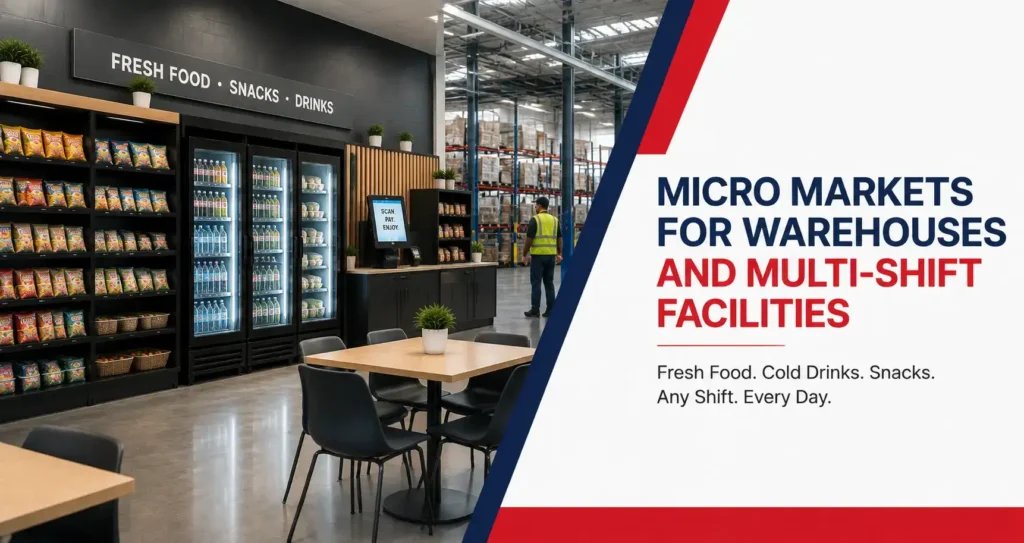
Warehouses and industrial facilities have very different break room needs from a typical nine-to-five office. Employees may start before sunrise, work overnight, rotate between shifts, or have scheduled breaks when nearby restaurants are closed. A warehouse micro market can provide onsite access to fresh meals, snacks, and cold beverages throughout those changing schedules.
Unlike a traditional cafeteria, a micro market does not depend on staffed serving hours. Employees can browse refrigerated cases and open shelves, select what they want, and complete purchases through a self-checkout kiosk. For multi-shift workplaces in St. Charles County, that flexibility can make the break room more useful throughout the day. Businesses evaluating a complete workplace market solution can also review our micro market vending guide to understand how setup, products, technology, and service work together.
Why Micro Markets Work Well in Warehouses
Warehouses often combine large employee populations, fixed break schedules, physically active jobs, and locations where leaving the property for food may not be practical. These conditions create a need for refreshments that remain accessible beyond standard lunch hours and are easy to access when several employees enter the break room at once.
A micro market addresses those needs by creating an unattended food area inside the facility. Rather than relying only on enclosed vending equipment, employees can browse a broader selection of refrigerated meals, drinks, snacks, and breakfast items while choosing several products in a single visit.
Food Is Available Beyond Traditional Business Hours
Second- and third-shift employees often have fewer nearby food options than daytime teams. Restaurants may be closed, delivery choices may be limited, and a short scheduled break may not provide enough time to leave the facility and return comfortably.
A 24-hour micro market gives employees access to food whenever their shift takes place. The market itself can remain available even when the service provider is not onsite, making the format particularly useful for distribution centers, manufacturing plants, logistics operations, and other facilities that operate well beyond normal office hours.
Employees Can Buy More Than a Quick Snack
Warehouse employees may need something more substantial than a packaged snack during a long shift. Refrigerated cases can hold sandwiches, wraps, salads, breakfast items, yogurt, protein packs, prepared meals, and other grab-and-go foods that are difficult to offer in a traditional snack machine.
Open shelving can still provide chips, bars, candy, nuts, crackers, and familiar favorites. Combining meals with snacks and beverages gives employees more flexibility depending on whether they are taking a short break or eating a full meal.
Self-Checkout Helps Serve Busy Break Periods
Warehouses often have concentrated break periods when several employees arrive in the break room within a short window. A self-checkout format allows employees to select multiple items and complete payment without waiting for a cashier or purchasing each item from a separate machine.
The effectiveness of checkout still depends on layout and employee traffic. The kiosk should be positioned so a short line does not block coolers, shelving, microwaves, or entrances during busy shift changes.
How Multi-Shift Schedules Change Micro Market Planning
A micro market serving one daytime team can be planned around fairly predictable breakfast and lunch demand. Multi-shift facilities are more complex because products must remain available across early mornings, afternoons, evenings, and overnight hours. Restocking only for the first shift can leave later employees with fewer choices.
Product capacity, refrigeration, service frequency, and inventory planning should therefore reflect the entire operating schedule. A strong micro market for shift workers considers the needs of every shift rather than allowing daytime purchasing patterns to determine what is available later.
First-Shift Demand
Early shifts can create stronger demand for breakfast foods, coffee-related beverages, water, protein items, pastries, and portable meals. Employees arriving before nearby restaurants open may rely more heavily on onsite options at the beginning of the day.
Lunch demand can also be concentrated if large groups break at similar times. Refrigerated meal capacity should account for that peak instead of focusing only on average hourly sales.
Second-Shift Demand
Second-shift employees may begin work when daytime restaurant options are still available but take their meal break much later. By that time, nearby choices can be reduced, and the workplace market may become more important.
The product mix should remain broad enough that these employees are not choosing only from what the first shift left behind. Sales patterns by time of day can help identify items that need additional inventory.
Overnight and Third-Shift Demand
Overnight employees often have the fewest outside food options. Fresh meals, filling snacks, bottled drinks, energy beverages, water, and breakfast foods can become especially relevant during these hours.
An unattended industrial micro market can give the third shift access to the same general level of convenience as daytime employees, provided restocking and inventory capacity are planned across the full workday.
What Should a Warehouse Micro Market Stock?
Warehouse micro market products should reflect longer shifts, physical activity, meal timing, and employee preferences rather than follow a standard office assortment. Product selection plays an important role in keeping a multi-shift market useful. Our guide on best micro market products explains how snacks, meals, beverages, and workplace demand influence the right assortment.
A worker taking a short break may want water and a quick snack, while someone on a meal period may need a complete lunch without leaving the building.
The strongest product mix usually combines recognizable favorites with fresh food and different portion sizes. Sales data should then guide adjustments so the market becomes more closely aligned with what employees actually purchase across each shift.
Fresh Meals and Grab-and-Go Food
Fresh food expands the market beyond traditional vending and can make the break room more useful for employees who stay onsite for meals. Sandwiches, wraps, salads, breakfast sandwiches, yogurt, fruit, protein packs, and prepared meals can all be considered depending on demand.
Refrigerated inventory should be planned carefully because fresh food requires regular rotation. A busy warehouse may support a larger selection, while a smaller facility may perform better with fewer products that are replenished more consistently.
Snacks for Short Breaks
Packaged products remain important because warehouse employees do not always have time for a full meal. Chips, crackers, nuts, trail mix, protein bars, granola bars, candy, popcorn, and other portable items give employees choices that can be eaten quickly.
The assortment should include several types of products instead of filling most shelf space with similar snacks. Variety helps the market serve different preferences without requiring an excessive number of items.
Cold Beverages and Hydration
Water is particularly important in warehouse and industrial environments where employees may spend much of the shift moving, lifting, loading, or working across large facilities. Bottled water can be supported by sparkling water, sports drinks, tea, soda, zero-sugar beverages, energy drinks, and other cold options.
Beverage demand may also change with the season. Warmer months or physically demanding operations can require greater cooler capacity and more frequent restocking than a climate-controlled professional office.
Businesses planning a broader refreshment program can review Best Vending’s micro market services to see how fresh food, snacks, beverages, refrigeration, and self-checkout can be combined in one workplace setup.
How Warehouse Micro Markets Differ From Office Micro Markets
The basic concept is the same in both environments: employees select products from open shelves or refrigerated cases and pay through a self-service checkout system. The operating conditions, however, can be very different because warehouses often have larger physical footprints, scheduled shift changes, concentrated traffic, and higher beverage demand.
An office market may experience steady use throughout the day, while a warehouse market can experience intense bursts of activity. That difference affects everything from cooler capacity and product selection to checkout placement, service access, and how much inventory is needed between restocking visits.
Warehouse Traffic Is Often More Concentrated
Office employees may take breaks at different times, which spreads demand across the day. Warehouse teams often follow structured schedules, meaning a large group can enter the break room within minutes.
The market should provide enough room for employees to move between shelving, refrigeration, and checkout without creating unnecessary delays. Layout becomes especially important when meal breaks are short.
Beverage Capacity May Need to Be Higher
Industrial facilities can generate substantial demand for bottled water and other cold drinks, particularly where employees are physically active or move between different temperature zones.
Additional refrigerated space may therefore be more valuable than adding several shelves of low-demand snacks. Product capacity should reflect actual purchasing behavior rather than following a standard office layout.
Restocking Needs Can Be More Complex
A high-traffic market serving several shifts may require more frequent service than a smaller office market. Fresh-food rotation, beverage volume, popular snacks, and overnight demand all influence how much inventory should be brought during each visit.
Remote sales and inventory information can help providers identify what is moving quickly before the next service visit and prepare a more relevant restocking load.
Restocking a Micro Market Across Multiple Shifts
A warehouse micro market service depends heavily on consistent restocking because the employee experience changes quickly when popular meals, snacks, or beverages disappear early in the day. A schedule that works for a daytime office may not be enough for a facility that operates sixteen or twenty-four hours.
Restocking should reflect sales volume, shift patterns, cooler capacity, employee count, fresh-food turnover, and seasonal demand. The goal is not simply to refill empty spaces but to keep a useful assortment available across the full operating schedule while avoiding excessive perishable inventory.
Sales Data Helps Identify Shift Patterns
Modern checkout systems can provide information about what employees purchase and when those transactions occur. That data can help distinguish daytime demand from evening or overnight purchasing patterns.
If breakfast sandwiches sell heavily before the first shift while refrigerated meals move later at night, those patterns can guide product quantities and service planning instead of relying only on assumptions.
Fresh Food Requires Closer Rotation
Fresh meals need more attention than shelf-stable snacks because they have shorter product lives and must remain properly refrigerated. The provider should balance variety with realistic sales volume so later shifts have options without creating unnecessary waste.
Regular product review can also identify which meal types, portion sizes, or flavors perform best with the workforce.
High-Demand Drinks Need Enough Capacity
Beverage cases can empty quickly in a busy facility, particularly during hot weather or physically demanding work shifts. Repeated sellouts may indicate that the market needs more facings, greater cooler capacity, or a different restocking schedule.
The same approach applies to high-volume snacks and meals. Inventory should adapt as demand becomes clearer.
Micro Market Layout for Warehouse Break Rooms
Warehouse break rooms need a layout that can accommodate employee traffic as well as product capacity. A large market is not automatically more effective if checkout lines block refrigerator doors, shelves narrow the walking path, or restocking carts cannot reach the equipment during service visits.
The micro market layout should reflect peak break traffic, not just how the room looks during quiet periods. Shelving, coolers, kiosks, microwaves, tables, and entrances should work together so employees can shop and move through the room without unnecessary congestion.
Proper planning of coolers, shelving, checkout placement, and employee movement is especially important in high-traffic facilities. Learn more about micro market design and space requirements when planning a warehouse installation.
Position Coolers for Fast Access
Cold beverages and fresh meals may be among the most frequently used areas in a warehouse market. Refrigerated cases should be easy to reach and have enough clearance for doors to open while employees stand nearby.
Placing the busiest cooler directly beside the checkout line can create unnecessary congestion. A more open arrangement keeps browsing traffic separate from employees completing payment.
Keep Checkout Away From Main Walkways
The kiosk should be visible but should not sit in the middle of the primary entrance or exit path. Employees waiting to scan items need enough standing room without blocking others who are entering, leaving, or heading toward seating.
Facilities with larger groups may need additional consideration for peak traffic, especially when everyone has a limited break window.
Preserve the Break Room Function
A warehouse micro market should improve the break room rather than replace it. Employees still need access to seating, microwaves, trash and recycling areas, sinks, and other features used during meal periods.
The market should occupy enough space to provide useful variety while leaving the room comfortable for people who are eating or resting.
Technology Supports 24-Hour Micro Market Access.
Technology allows an unattended market to function across shifts without requiring a cashier to be present. Self-checkout systems can process purchases while sales records, inventory tools, and security features help the provider manage the market between service visits.
For warehouse operations, these systems are particularly useful because employee access may continue long after traditional business hours. Technology does not eliminate the need for service, but it can help make that service more informed and responsive to actual market activity.
Cashless and Mobile Payments
A self-checkout kiosk may accept credit cards, debit cards, tap-to-pay, mobile wallets, or market accounts depending on the system. This allows employees to purchase several products in one transaction without needing exact cash.
Clear payment instructions and reliable connectivity are important because a market that remains open overnight still needs checkout to function when no service representative is onsite.
Remote Inventory Visibility
Sales information can help identify products that are selling quickly, items that are moving slowly, and categories that need more capacity. That visibility can make restocking more efficient because the provider has a better idea of what the market needs before arriving.
Remote data is most useful when combined with service visits and employee feedback rather than treated as a replacement for local support.
Security and Transaction Monitoring
Because products are displayed openly, micro markets typically use a combination of visible cameras, transaction records, and workplace access controls. These tools can help support an unattended retail environment while allowing employees to browse products freely.
The exact security setup depends on the facility, market location, and service arrangement.
Micro Markets Can Complement Warehouse Vending
A large facility does not have to choose between a micro market and vending machines in every part of the building. A central market may provide fresh meals and broad product variety in the main break room, while traditional vending serves distant departments, production areas, loading zones, or secondary employee spaces.
This hybrid model can be useful where the building footprint makes one central location inconvenient for some employees. The purpose of each refreshment point should be based on how teams move through the facility and how much time they have during breaks.
Use the Micro Market as the Main Food Destination
The central break room is often the strongest location for fresh food, open shelving, and self-checkout because employees already visit it for longer breaks and meals.
A market in this area can provide greater variety while keeping refrigerated food in one managed location.
Use Vending for Remote or Quick-Access Areas
Traditional vending may be more practical in parts of the facility where employees only need a quick beverage or snack and do not have enough traffic to support another full market.
This approach helps extend refreshment access without duplicating a large setup throughout the building.
Match Each Service to Employee Behavior
The decision should be driven by distance, traffic, shift schedules, and product demand. Employees working far from the main break room may benefit from additional access points even when a central market is available.
Best Vending’s industries page provides additional context for workplace refreshment planning across warehouse, industrial, office, healthcare, and other facility types.
Supporting Warehouse Employees With Broader Break Room Services
Food availability is only one part of a warehouse break room. Employees may also rely on coffee before an early shift, filtered water throughout the day, or employer-sponsored snacks during particularly demanding work periods. These services can be planned alongside the micro market rather than duplicating its role.
A coordinated break room program can separate employee-purchased food from employer-provided refreshments while keeping the space organized. The right combination depends on company culture, workforce size, operating hours, available room, and the types of amenities the employer wants to support directly.
Coffee for Early and Overnight Shifts
Coffee demand may begin well before a typical office morning in facilities with early start times. Overnight employees may also rely on coffee during hours when nearby cafés are unavailable.
A separate coffee station can reduce traffic around the micro market checkout area and provide a dedicated beverage option throughout the shift.
Water for Physically Active Teams
Hydration can be particularly important in large facilities where employees walk substantial distances or perform physical work. A managed water solution can complement bottled beverages in the market.
Businesses considering separate beverage support can review Best Vending’s office coffee and water service as part of a wider break room plan.
Employer-Sponsored Refreshments
Some employers may choose to provide selected snacks, beverages, or pantry items directly to employees while using the micro market for additional purchases.
Keeping these programs clearly organized helps employees understand which products are employer-sponsored and which are purchased through the self-checkout system.
Warehouse Micro Markets in St. Charles County
Warehouses and industrial operations throughout St. Charles County can have very different refreshment needs depending on workforce size, location, shift structure, and building layout. An O’Fallon distribution center running around the clock may require a different market than a St. Peters facility operating two scheduled shifts or a smaller industrial workplace in St. Charles.
Local planning should account for how employees actually use the facility. Nearby restaurant access, break length, employee traffic, beverage demand, existing vending equipment, refrigeration space, and restocking access can all influence whether a particular warehouse micro market design will work well over time.
O’Fallon and St. Peters Facilities
Large employment areas in O’Fallon and St. Peters can include distribution, industrial, logistics, service, and manufacturing workplaces where employees may work outside normal restaurant hours.
For these locations, onsite access to fresh food and beverages can be particularly useful when employees have fixed break periods or limited time to leave the property.
St. Charles and Surrounding Communities
Facilities in St. Charles and nearby communities may vary from smaller industrial teams to larger multi-shift operations. The right market size should reflect actual employee traffic rather than assuming every warehouse needs the same equipment.
A site-specific approach makes it easier to select appropriate refrigeration, product capacity, and checkout placement.
Local Service Matters
A market that operates across several shifts still depends on regular restocking, fresh-food rotation, equipment support, and communication with the employer.
Working with a local service team can make it easier to adjust product selections, review changing demand, and respond when the market or equipment needs attention.
Build a Better Break Room for Every Shift
A warehouse micro market can give employees more reliable access to food and drinks when their schedules do not match traditional restaurant hours. Fresh meals, snacks, cold beverages, self-checkout, and flexible product selection can serve early, daytime, evening, and overnight teams from the same centrally managed break room.
The strongest program is built around actual employee traffic rather than a generic warehouse template. Best Vending helps St. Charles County workplaces plan micro markets around shift schedules, fresh-food demand, break room space, product usage, and existing refreshment services so the market can remain useful throughout the full operating day.
Frequently Asked Questions
A warehouse micro market is an unattended food and beverage area with open shelving, refrigerated cases, and self-checkout technology. Employees can browse products and purchase meals, snacks, and drinks onsite without requiring a staffed cafeteria or cashier during each shift.
Yes. A micro market can remain accessible during second, third, and overnight shifts because employees complete purchases through a self-checkout system. Product capacity and restocking should be planned carefully so later shifts still have useful food and beverage choices available.
Common choices include sandwiches, wraps, salads, prepared meals, breakfast items, yogurt, protein packs, chips, nuts, bars, candy, fruit, bottled water, sports drinks, soda, tea, and energy beverages. The best selection depends on workforce preferences and actual sales.
There is no single schedule for every facility. Restocking frequency depends on employee count, number of shifts, product sales, cooler capacity, fresh-food turnover, and seasonal demand. High-traffic multi-shift facilities may require more frequent service than smaller workplaces.
It depends on the facility. A micro market can provide more fresh food and product variety, while vending can work well in smaller or remote areas. Large warehouses may use a central micro market and keep vending machines in other parts of the building.
A self-service market can remain accessible throughout a 24-hour operation when the facility allows employee access and the checkout, refrigeration, payment, and security systems are functioning properly. The service plan should also account for inventory demand across all shifts.
Depending on the kiosk system, employees may be able to pay with credit cards, debit cards, mobile wallets, tap-to-pay, or market accounts. Transactions are processed through the self-checkout system rather than through a staffed register.
Yes. Product selection can be adjusted based on employee requests, sales patterns, shift demand, fresh-food performance, and seasonal changes. A multi-shift facility may also need different quantities of certain products at different times of the day.