
Micro markets are often associated with large corporate offices, warehouses, and facilities with hundreds of employees, but workplace size alone does not determine whether the concept will work. A smaller office can sometimes support a compact micro market when employee attendance, food demand, available space, and daily purchasing habits create enough consistent use.
The more useful question is not simply whether an office is “too small.” Employers should look at how many people are onsite each day, whether employees leave for meals, how long breaks last, what food is available nearby, and whether the workforce wants fresh meals in addition to packaged snacks and beverages.
Can a Small Office Really Support a Micro Market?
A small office can be a good candidate for a micro market when there is enough consistent demand to justify refrigerated products, shelving, checkout technology, and regular service. The market does not have to resemble the larger installations used in manufacturing plants or distribution centers because a compact configuration can be designed around a smaller workforce and a narrower product assortment.
At the same time, not every small office needs a micro market. Some workplaces may be better served by vending machines or an employer-sponsored pantry, particularly when attendance changes frequently, or employees rarely purchase meals onsite. The right answer depends on employee behavior rather than a fixed workforce threshold.
Daily Attendance Matters More Than Total Headcount
An office may employ 75 people but only have 25 onsite on a typical day because of hybrid schedules, field work, travel, or flexible attendance. Another company with 35 employees may have nearly everyone onsite every weekday, creating more consistent break room traffic.
For that reason, the number of people physically using the workplace is usually more important than the total number listed on payroll. Reliable daily traffic gives a small office micro market a better opportunity to maintain useful product turnover and support a varied assortment.
Employee Buying Habits Matter Too
A workplace where employees already leave the building for every meal may initially generate less micro market usage than a similar office where staff routinely eat at their desks or in the break room. Nearby restaurants, lunch schedules, parking, and travel time can all influence purchasing behavior.
Employers should think about what employees currently do when they need breakfast, lunch, a drink, or an afternoon snack. A market becomes more useful when it solves an existing convenience problem rather than simply adding equipment to the room.
A Compact Setup Can Change the Equation
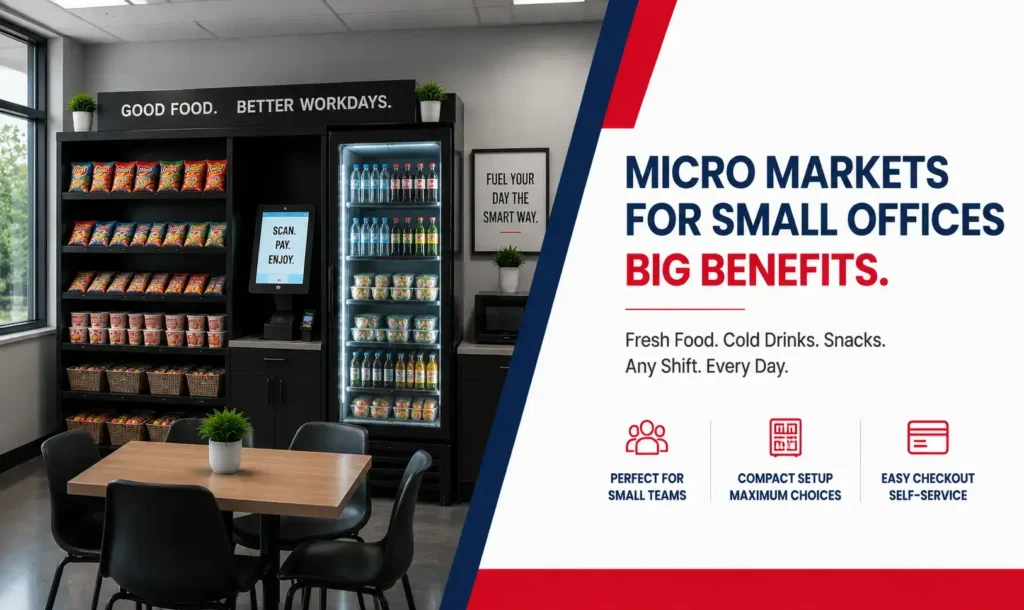
A small workplace does not necessarily need several coolers or long rows of shelving. One refrigerated case, a carefully selected snack area, and a self-checkout kiosk may be enough while still preserving seating and food preparation space.
This smaller footprint can give employees more variety than a traditional vending setup without requiring the office to dedicate a large room to refreshment equipment.
What Does a Small Office Micro Market Look Like?
A workplace market uses the same basic concept as a larger installation but scales its equipment and inventory to match employee demand. Open shelving can hold packaged snacks, while a refrigerated case provides cold drinks and selected fresh food. Employees then scan and purchase items through a self-checkout system rather than using a staffed register.
The goal should be to create enough choices to make the market useful without overcrowding the break room or stocking more perishable inventory than employees can purchase. Layout, refrigeration, checkout placement, and seating all need to work together within the smaller available footprint.
Compact Shelving
Small office markets often benefit from vertical shelving rather than wide floor displays. Using available wall space allows packaged products to remain visible while leaving more room for employees to move through the break room.
The assortment can include familiar salty snacks, sweet products, protein bars, nuts, breakfast items, and other portable choices. Shelf space should be adjusted based on sales instead of trying to represent every possible snack category from the beginning.
One Well-Planned Refrigerated Area
A smaller office may not need separate coolers for meals and beverages. One properly sized refrigerated case can sometimes support bottled drinks, yogurt, sandwiches, wraps, salads, fruit, and other grab-and-go food.
The assortment needs to reflect actual demand because fresh products require regular rotation. A tightly managed selection often makes more sense than filling a large cooler simply to create the appearance of variety.
Simple Self-Checkout
The checkout area should be easy to understand and quick to use. Employees may be able to pay by card, mobile wallet, tap-to-pay, or another method supported by the kiosk.
Businesses considering this format can review Best Vending’s micro market services to understand how refrigeration, shelving, checkout technology, and product management can be adapted to different workplace environments.
How Much Space Does a Small Office Micro Market Need?
Small-office installations depend more on usable space than the overall size of the room. A break room may look relatively large until tables, chairs, cabinets, microwaves, sinks, windows, and doorways are taken into account. The market should fit into the remaining area without making employees squeeze around equipment during busy periods.
A compact micro market can often be planned along one available wall or corner, provided there is suitable electrical access, enough room for cooler doors to open, and a practical place for the kiosk. Preserving the room’s original purpose should remain part of the design.
Small workplaces need careful planning because every part of the break room must remain functional. Learn more about micro market design and space requirements when evaluating layout, equipment placement, and employee movement.
Use Wall Space Efficiently
Wall-mounted or vertical product displays can provide meaningful capacity without consuming the center of the room. Coolers can also be positioned along walls where employees can browse without blocking entrances or seating.
The layout should avoid putting the checkout area directly in front of refrigeration because even a small group of employees waiting to pay can prevent others from reaching food and drinks.
Keep Seating and Food Preparation Accessible
A break room still needs to function as a break room after the market is installed. Employees should retain reasonable access to tables, chairs, microwaves, sinks, waste bins, and other everyday features.
Removing too much seating to fit additional equipment may make the overall employee experience worse even if the market itself looks impressive. A smaller market with better room balance is often the stronger choice.
Plan for Restocking Access
Service personnel need enough room to bring beverages, fresh food, and packaged products to the market without moving furniture or blocking major walkways.
This operational detail is easy to overlook in a small space. A market should be convenient to maintain as well as convenient for employees to use.
What Products Work Best in a Small Office Micro Market?
Product selection becomes especially important in a smaller market because shelf and cooler space is limited. A large facility can dedicate space to niche products and still maintain wide variety, while a compact market needs to prioritize items with consistent demand and enough choice to serve different employee preferences.
The initial assortment should combine snacks, beverages, breakfast options, and selected fresh food without overloading any one category. Sales patterns can then show which products deserve more room and which items should be replaced with something employees are more likely to buy.
Start With High-Use Categories
Packaged snacks and cold beverages usually provide a practical foundation because employees may purchase them at different times throughout the day. Water, soft drinks, tea, sparkling beverages, chips, crackers, nuts, bars, and familiar snack items can cover several different occasions.
A small market does not need six nearly identical versions of the same product. Variety should come from different categories rather than unnecessary duplication.
Add Fresh Food Carefully
Fresh meals can make a micro market more useful, but a smaller office needs to balance choice with realistic turnover. Sandwiches, wraps, salads, yogurt, fruit, breakfast items, and protein packs can be introduced in manageable quantities.
Products that consistently sell can receive more space over time, while slow-moving fresh items can be reduced before they create unnecessary waste.
Reflect the Actual Workday
A workplace where employees arrive early may need breakfast items, while an office with long afternoon meetings may see stronger snack and beverage demand. Employees who regularly stay onsite for lunch may support a larger fresh-food selection.
The market should therefore be built around the rhythm of the office rather than following a generic list of recommended products.
Micro Market vs Vending vs Office Pantry for a Small Office
A micro market is only one way to provide workplace refreshments, so smaller employers should compare it with simpler alternatives before deciding. Traditional vending uses less open space and keeps products enclosed, while an office pantry allows the employer to sponsor selected snacks or drinks without requiring employees to complete individual purchases. Employers comparing a self-service market with an employer-sponsored refreshment program can review our guide on micro market vs office pantry to understand the differences between these options.
The best fit depends on whether the business wants broader employee-paid food access, a compact automated solution, or an employer-sponsored amenity. Some offices may even combine two models when different products serve different purposes.
| Option | Best Fit for a Small Office | Main Advantage |
| Micro Market | Offices with consistent attendance and fresh-food demand | Broad product choice and self-checkout |
| Vending | Offices with limited space or moderate traffic | Compact, enclosed equipment |
| Office Pantry | Employers wanting to provide snacks directly | Employer-sponsored employee amenity |
| Hybrid Program | Offices with several refreshment goals | Combines paid and sponsored options |
When a Micro Market Makes More Sense
A micro market becomes attractive when employees want more than snacks and canned drinks. Fresh lunches, refrigerated food, breakfast options, and a broader beverage assortment can make the market useful throughout the day.
It can also work well where employees have limited time to leave the building or where nearby restaurants are difficult to reach.
When Vending Makes More Sense
Traditional vending may be better when floor space is tight, employee traffic is inconsistent, or the workplace mainly needs quick snacks and beverages.
A smaller vending setup also requires less open retail space, which can be useful in offices where break rooms are already crowded with seating, cabinets, and food preparation equipment.
When an Office Pantry Makes More Sense
An employer-sponsored pantry can be a strong option when the primary goal is to provide selected snacks and drinks as an employee benefit rather than create a retail food environment.
Best Vending’s office pantry service can support workplaces that want to choose and fund a focused assortment based on budget, employee preferences, and company culture.
When Does a Small Office Benefit Most From a Micro Market?
A small office micro market tends to work best when it solves a real workplace need. Employees may have limited nearby food options, short lunch periods, long workdays, or a company culture where people frequently remain onsite during breaks. Those conditions can create more consistent demand than workforce size alone might suggest.
A smaller market can also be valuable when the office wants to offer more variety than vending provides but does not need a staffed cafeteria. Refrigerated food and self-checkout can create that middle ground when daily employee usage supports the program.
Limited Nearby Food Options
An office located in a business park, industrial area, or suburban employment center may not have restaurants within convenient walking distance. Employees may need to drive several minutes each way simply to purchase lunch.
An onsite market can reduce that dependence by providing food and beverages within the building, particularly when short breaks make offsite trips inconvenient.
Employees Frequently Eat Onsite
Some offices naturally generate stronger break room use because employees bring meals, work through busy schedules, or prefer eating with coworkers instead of leaving the property.
When that behavior is already established, adding fresh meals and additional snack choices may fit the way employees use the workplace rather than trying to create an entirely new habit.
Workdays Extend Beyond Standard Hours
Professional offices are not always limited to nine-to-five schedules. Accounting firms, customer support operations, engineering teams, healthcare offices, and other businesses may have employees arriving early, staying late, or working changing schedules.
A self-service market can remain available during those hours without requiring staffed food service.
How Hybrid Work Affects Small Office Micro Markets
Hybrid schedules can make refreshment planning more difficult because onsite attendance may change significantly from one day to another. An office may be busy Tuesday through Thursday but much quieter on Monday and Friday, creating uneven demand for fresh food and beverages.
That does not automatically rule out a small workplace micro market, but product quantities and service planning need to reflect actual attendance patterns. Overstocking fresh food for peak headcount can create waste when only part of the workforce is regularly onsite.
Focus on Typical Attendance
Hybrid schedules can make refreshment planning more difficult because onsite attendance may change significantly from one day to another. Average and peak attendance both matter because the market needs enough capacity for busy days without being oversized for the rest of the week.
Attendance patterns can also change seasonally or as workplace policies evolve, so the assortment should remain flexible.
Adjust Fresh Food Quantities
Packaged snacks and beverages can usually tolerate uneven usage better than short-life refrigerated food. Fresh meal quantities should therefore be reviewed carefully when attendance fluctuates.
Sales data can help the provider understand which days generate the most demand and adjust inventory accordingly.
Use Other Services to Fill the Gaps
A hybrid office might use a compact micro market for employee-paid food while also offering coffee, water, or selected employer-sponsored snacks that remain useful even on quieter days.
A coordinated refreshment program can provide flexibility without forcing every service into one model.
How Small Offices Can Keep a Micro Market Useful Over Time
Installing the market is only the beginning. In a smaller workforce, a few employee preferences can have a noticeable effect on sales, making regular product reviews especially useful. Regular assortment reviews are therefore particularly valuable in compact markets where each cooler slot and shelf position should earn its place.
The market should evolve as attendance, preferences, work schedules, and company size change. The goal is not to preserve the original product plan indefinitely, but to keep the market aligned with how employees actually use the break room.
Review Product Performance
Popular products may need more facings, while consistently slow sellers should be reduced or replaced. Fresh food deserves particular attention because excessive quantities can create avoidable waste.
Sales information and service observations can help identify those patterns without relying solely on occasional employee comments.
Listen to Employee Requests
Employees may ask for a particular beverage, snack, vegetarian meal, or breakfast item that has never been tested in the market. Reasonable requests can help uncover demand that existing sales data cannot show.
Not every request needs to become a permanent product. New items can be introduced in limited quantities and evaluated based on actual usage.
Adjust as the Office Grows
A small business may add employees, increase in-office attendance, or expand operating hours. The market should be able to adapt to those changes where the room and service model allow.
Additional shelving, refrigeration, or complementary services can be considered when demand consistently exceeds the original setup.
Small Office Micro Markets in St. Charles County
Small and mid-sized businesses throughout St. Charles County operate in professional buildings, business parks, medical offices, dealerships, industrial areas, and mixed-use employment centers. Their food access can vary widely depending on location, employee schedules, and whether nearby restaurants are practical during short breaks.
A small office micro market in St. Charles County should therefore be evaluated based on actual workplace conditions. A 30-person team in O’Fallon with limited nearby lunch options may have different refreshment needs than a similarly sized office in St. Charles where restaurants are close, and many employees leave at midday.
St. Charles Offices
Professional offices in St. Charles may benefit from compact markets when employees regularly remain onsite for breakfast, lunch, or afternoon breaks. Fresh food demand, hybrid attendance, and available break room space should all influence the setup.
Smaller markets can focus on a carefully selected assortment rather than trying to imitate a large corporate installation.
O’Fallon and St. Peters Workplaces
Businesses in O’Fallon and St. Peters can include professional offices located near industrial and commercial areas where lunch access varies by building and work schedule.
For these locations, employee traffic and nearby food availability should be considered alongside workforce size when deciding whether a market is practical.
Local Service Supports a Smaller Program
Smaller markets benefit from close attention to product performance because excess inventory can create waste more quickly than it would at a large facility.
A local service team can help adjust product quantities, fresh-food selection, and restocking patterns as actual employee behavior becomes clearer.
Choose the Refreshment Program That Fits Your Small Office
A micro market can be a good fit for a small office, but the decision should consider employee demand, available space, interest in fresh food, and how people use the break room. A compact market can offer much of the convenience of a larger installation without filling the room with unnecessary equipment or inventory.
Best Vending works with St. Charles County workplaces to evaluate whether a micro market, vending solution, employer-sponsored pantry, or combination of services makes the most sense for the workforce. The right program should match the office as it operates today while leaving enough flexibility to adapt as attendance, employee preferences, and workplace needs change.
Frequently Asked Questions
There is no single employee-count requirement that applies to every workplace. Daily attendance, purchasing behavior, fresh-food demand, work schedules, and available space all influence whether a market is practical. A smaller office with consistent onsite attendance can sometimes support a market more effectively than a larger hybrid workplace with irregular traffic.
It may be possible depending on the workplace. A compact setup with limited shelving, one refrigerated unit, and a smaller product assortment can be considered when there is consistent employee use. The provider should evaluate expected demand before recommending equipment.
Neither option is automatically better. A micro market offers broader food variety and fresh products, while vending uses less space and may suit locations with moderate traffic. The right choice depends on employee needs, available space, and expected usage.
Space requirements depend on refrigeration, shelving, checkout equipment, seating, and existing break room features. Compact markets can sometimes use one available wall or corner, provided employees can still move comfortably and access microwaves, tables, and other amenities.
Yes, provided there is suitable refrigeration and enough consistent demand to support fresh-food turnover. Sandwiches, wraps, salads, yogurt, fruit, and breakfast items can be stocked in quantities that reflect actual employee usage.
Not necessarily. Hybrid schedules make demand less predictable, so the market should be planned around typical daily attendance rather than total headcount. Fresh-food quantities and service frequency may also need to change between busy and quiet office days.
It can be. An employer-sponsored pantry may be easier to scale when the company mainly wants to provide snacks or beverages as an employee amenity. The employer can control the assortment and budget without requiring a full self-checkout retail setup.
Yes, when space and service conditions allow. Additional shelving, refrigeration, product categories, or complementary break room services can be added as employee count and market usage grow. A flexible initial layout can make later expansion easier.